MKundali Decode. Analyse. Predict.

Jamakkol workspace

Jamakkol Prashna Software for Udaya Lagna and Jama Graha Analysis

Explore Jamakkol Prashna through Udaya Lagna, eight Jama Grahas, Aarudha, Kavippu, planetary exchanges and specialised analytical tools.

MKundali brings Jamakkol Prashna into a dedicated workspace. Calculate Udaya Lagna, examine the eight Jama Grahas, identify special entities and planetary exchanges, and explore supporting tools such as Rashmis, Arc Distance Matrix and Varsha Vimsottari.

Calculate a chart using the main Chart Entry first, then open the Jamakkol workspace to examine its Udaya and associated Jama Graha positions.

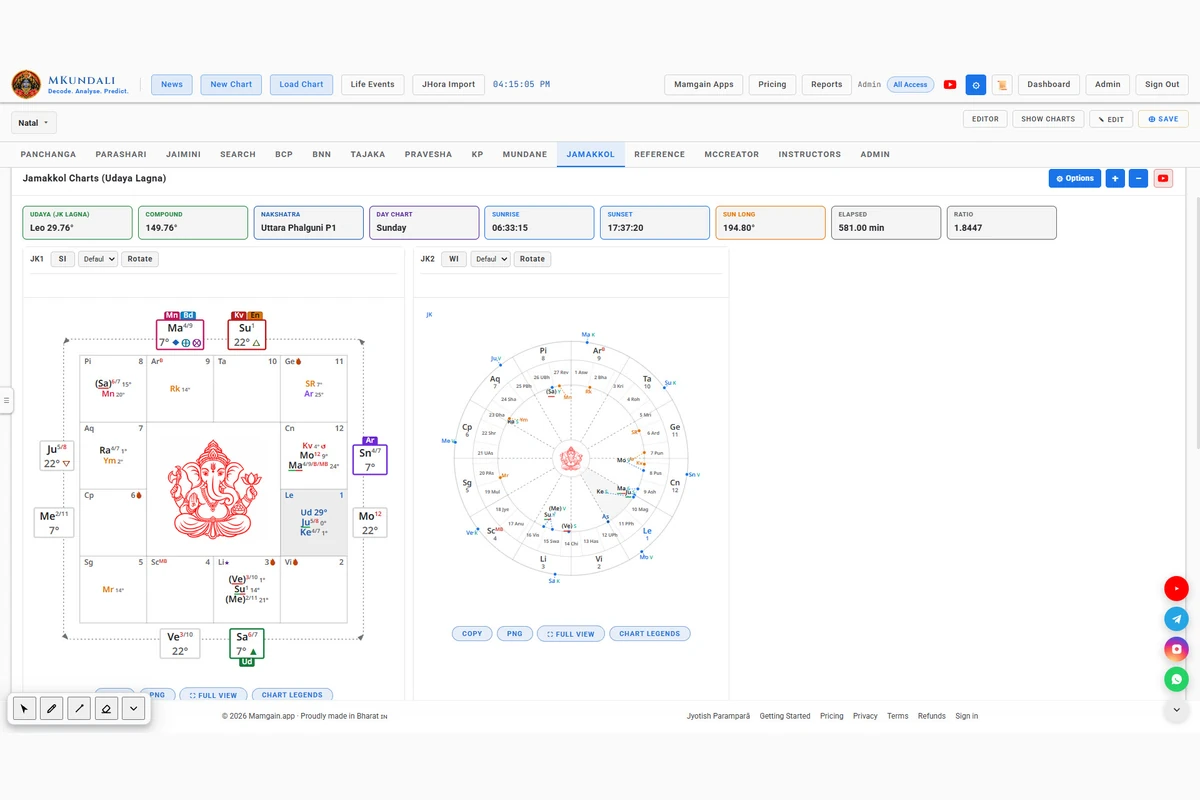
MKundali Jamakkol workspace with the Udaya Lagna summary bar and chart

Workspace overview

One Jamakkol Workspace, Many Components

The Jamakkol tab is a single scrolling workspace. After a chart is calculated, its sections show the Udaya and Jama charts, the derived points, the analysis, and the timing and reporting tools.

  1. 1Udaya LagnaThe Jamakkol ascendant
  2. 2Jama GrahasEight outer positions
  3. 3ChartsStandard and divisional
  4. 4EntitiesPoints and Upagrahas
  5. 5Aarudha, Kavippu, SRDerived points
  6. 6AnalysisApproaches and exchanges
  7. 7Bhava PositionsAnd Varga Bhava
  8. 8RashmisRay values by sign
  9. 9Varsha VimsottariMudda Dasa timing
  10. 10Arc Distance MatrixEntity-to-entity arcs
  11. 11Dagdha RashisTithi-based signs
  12. 12YogasInner chart
  13. 13ReportsPreview and print

The Jamakkol workspace is not a separate set of tabs: these components are sections within one tab. Some tools may be restricted to certain subscription plans. See the Pricing page for current availability.

Component 1

Udaya Lagna – Calculate the Jamakkol Ascendant

Udaya, also known as Jamakkol Lagna, is the foundation of the Jamakkol workspace. MKundali calculates its position using the birth time, the Sun’s longitude and the duration of daytime or nighttime.

How It Is Calculated

  1. Obtain the Sun’s longitude.
  2. Identify sunrise and sunset from Panchanga.
  3. Calculate Dinamana (day duration).
  4. Calculate Ratrimana (night duration).
  5. Identify whether the birth moment falls during daytime or nighttime.
  6. Determine the elapsed time from the applicable sunrise or sunset boundary.
  7. Calculate the Udaya longitude from the elapsed time, the day or night duration and the Sun’s longitude.

Udaya is not the ordinary natal Lagna. If Panchanga sunrise or sunset is unavailable, the engine uses a 06:00 and 18:00 fallback. That fallback is not the Jama Graha 6-to-6 option.

Udaya Information

  • Udaya sign and sign number
  • Degree and compound longitude
  • Nakshatra and Pada
  • Rashi Lord, Nakshatra Lord and Sub Lord
  • SSS and deeper KP divisions
  • Day or Night classification
  • Vedic weekday
  • Sunrise and sunset
  • Dinamana and Ratrimana
  • Elapsed time
  • Calculation ratio

Udaya and the Houses

Jamakkol houses are counted from the Udaya Lagna, so the Jamakkol charts, the Planetary Positions table and the Analysis rows use houses from Udaya.

The 6-to-6 option described under Jama Grahas affects the Jama Grahas only. It does not change Udaya.

MKundali Jamakkol workspace with the Udaya Lagna summary bar and chart
Udaya Lagna summary and chart.

Component 2

Jama Grahas – Eight Outer Planetary Positions

MKundali calculates eight Jama Graha positions using the elapsed portion of daytime or nighttime and a weekday-dependent planetary sequence.

The Eight Jama Grahas

  • Sun
  • Moon
  • Mars
  • Mercury
  • Jupiter
  • Venus
  • Saturn
  • Snake

Snake is a Jama Graha in its own right. It is not a Rahu or Ketu position, and it is excluded from the exchange calculations.

Eightfold Day or Night Division

Daytime and nighttime are divided into eight equal periods. The applicable Jama period is determined from the selected birth moment.

  • Active Jama number
  • Jama duration
  • Engine Graha
  • Elapsed time within the active Jama
  • Engine longitude
  • Day or Night
  • Vedic weekday

MKundali determines the starting Engine Graha from the Vedic weekday. The other seven Jama Grahas follow the corresponding sequence, each 45 degrees from the previous position.

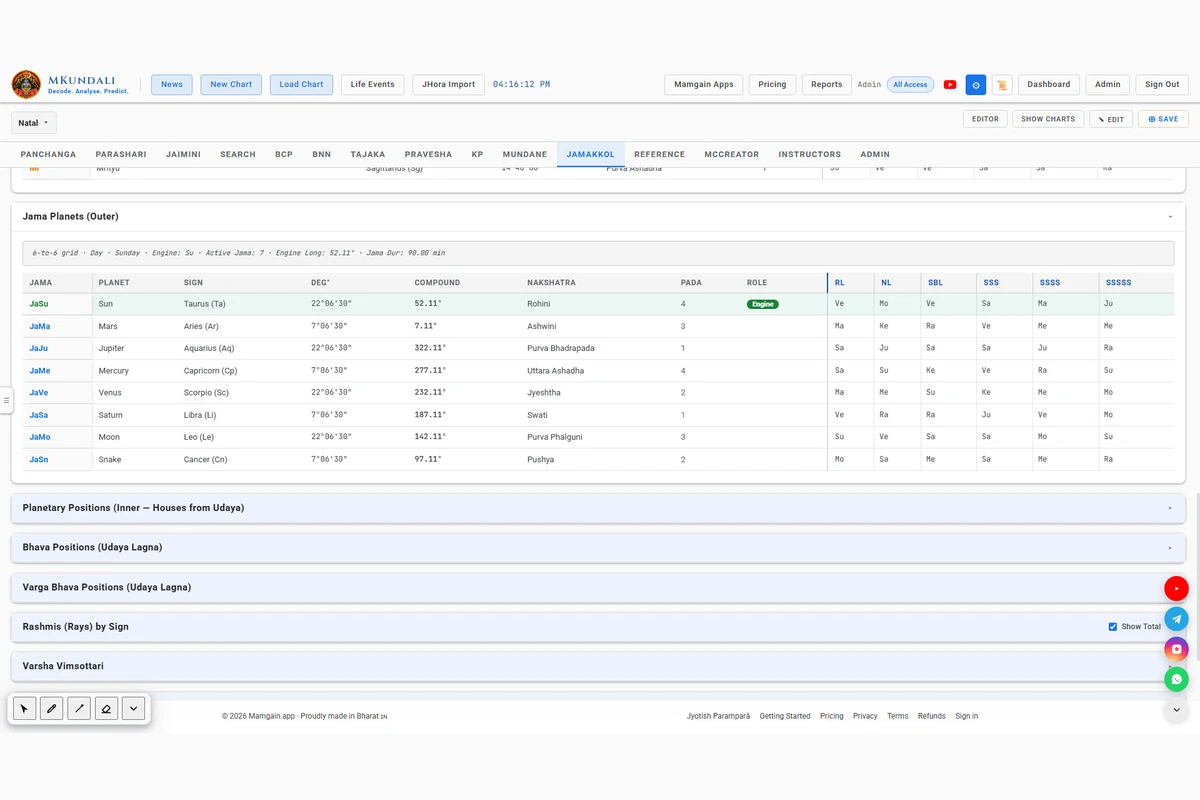
Jama Planets Table

  • Jama number and planet
  • Sign, degree and compound longitude
  • Nakshatra and Pada
  • Role or Engine identification
  • RL, NL, SBL, SSS, SSSS and SSSSS

Actual Sunrise–Sunset or 6-to-6 Mode

The actual SR/SS mode uses the sunrise and sunset boundaries. The optional 6-to-6 mode uses a fixed 06:00 to 18:00 daytime framework. Changing the mode recalculates the Jama Graha positions.

This setting affects the Jama Graha calculation. It does not replace the separate Udaya sunrise and sunset calculation. The workspace opens with 6-to-6 mode switched on.

MKundali Jamakkol Jama Planets table with the eight Jama Grahas
The eight Jama Grahas.

Component 3

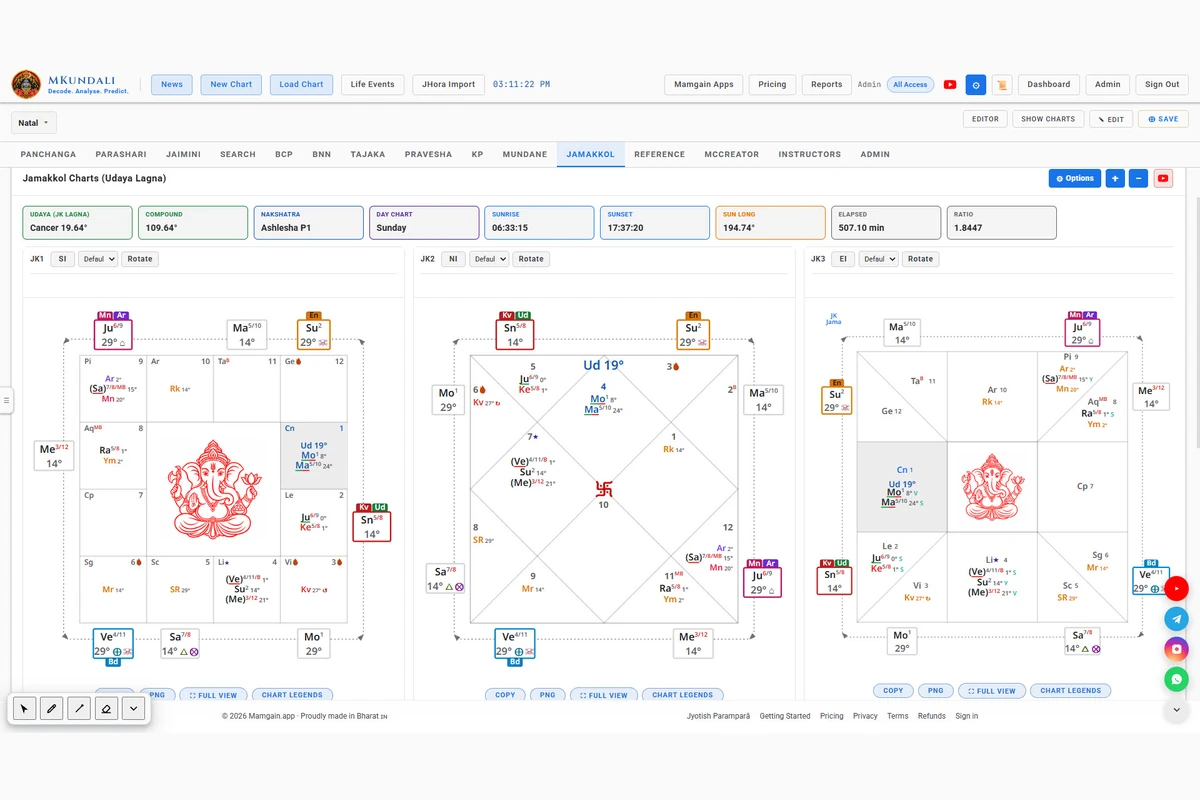
Jamakkol Charts – Visualise Udaya, Inner Planets and Jama Grahas

MKundali provides dedicated Jamakkol charts based on Udaya Lagna. The chart combines the inner planetary positions with the eight Jama Graha positions and special Jamakkol entities.

Standard Charts

  • Multiple chart slots, with Add and Remove controls
  • North, South, East and Western chart styles
  • Chart rotation
  • Inner planets and Jama Grahas in one view
  • Jamakkol entities on the chart

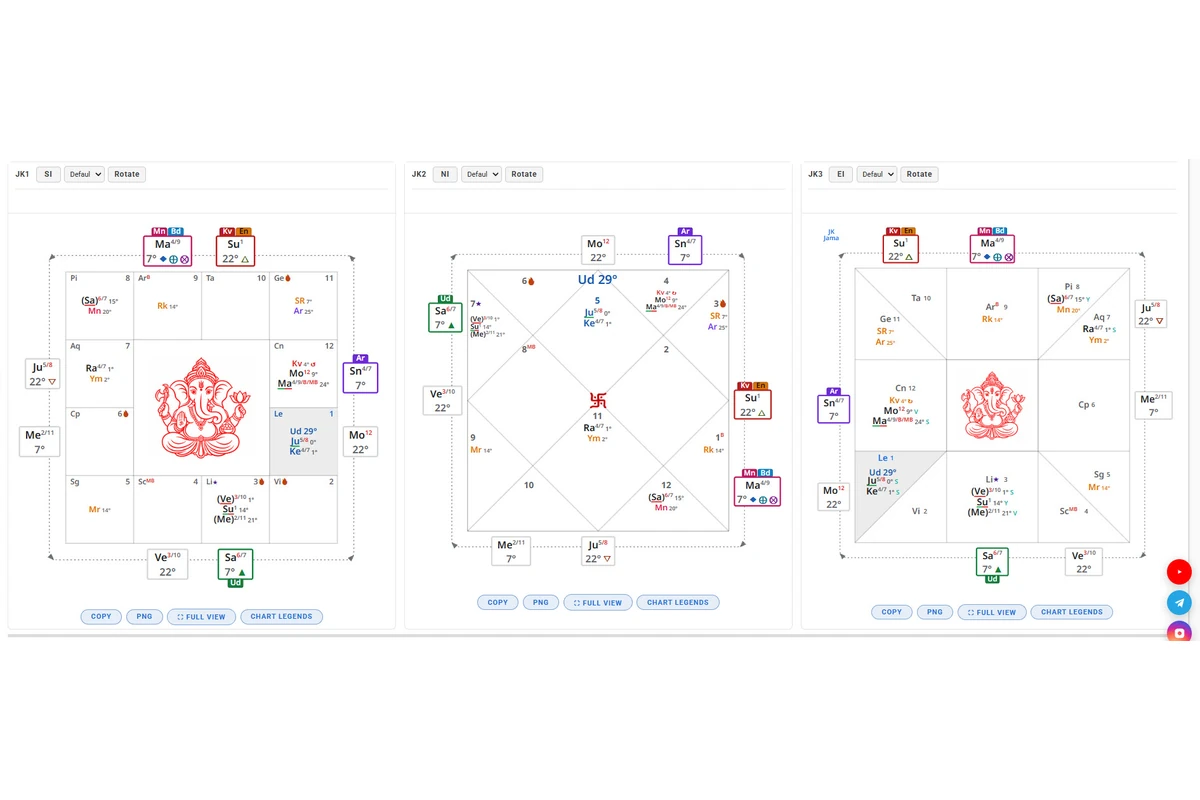
Desktop opens three standard slots (South, North and East), and phone-width screens open one. You can add or remove slots.

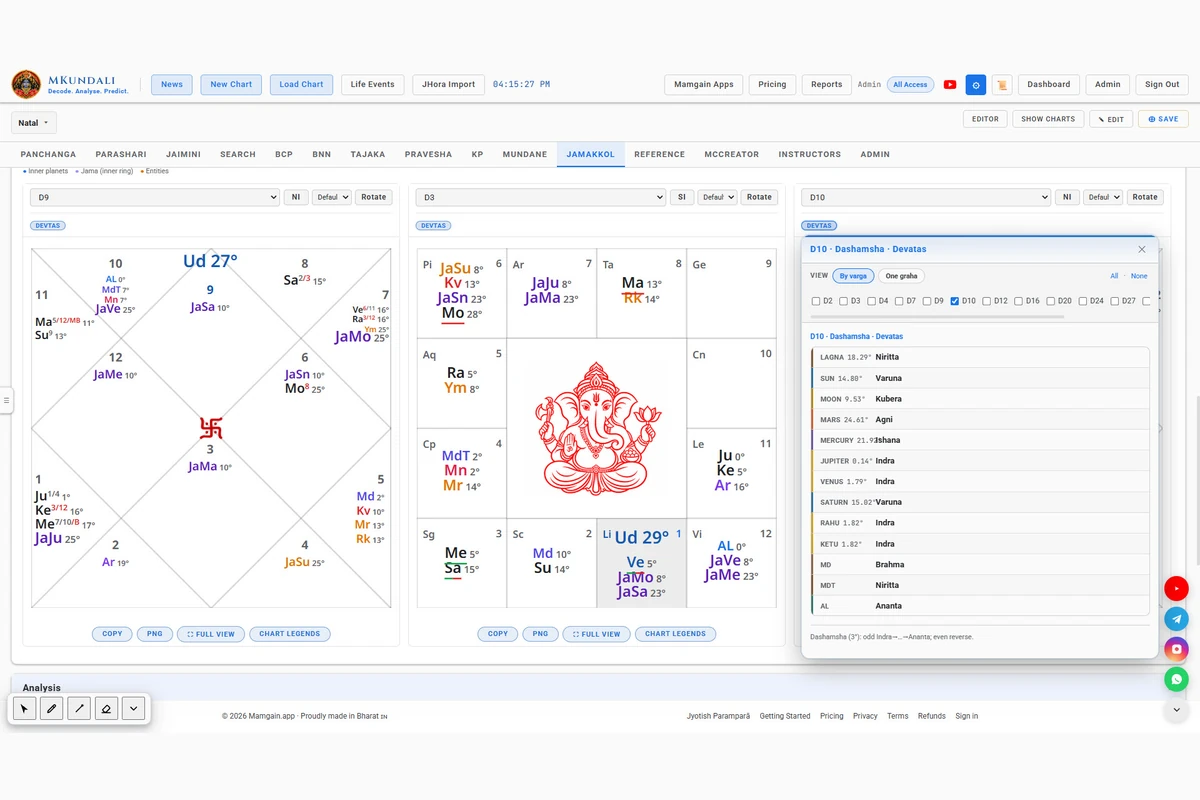
Divisional Charts

  • Slots for chosen divisional charts, with Add and Remove controls
  • D9, D3 and D10 as the default slots on desktop
  • Selection from D1 through D60, plus D81, D108 and D144
  • Inner planets, Jama Grahas and entities, each shown distinctly

The divisional section opens collapsed.

Chart Display Options

The Options flyout controls what a chart shows.

  • Show Degrees
  • Show Flags
  • Show Houses
  • Show Inner Planets
  • Show Aspect Arrows
  • Show Rashi Drishti
  • Show Argalas
  • Show Graha Card
  • Show Rahu/Ketu Midpoints
  • Show Lordships
  • Show Planet’s Star Lord
  • Show Planet’s Sub Lord
  • Show Avasthas

Show Total Rashmis and the 6-to-6 mode sit in the same flyout under Calculation Options.

MKundali Jamakkol standard charts with inner planets and Jama Grahas
Standard Jamakkol charts.
MKundali Jamakkol divisional chart slots
Divisional charts from the Udaya Lagna.

Component 4

Jamakkol Entities

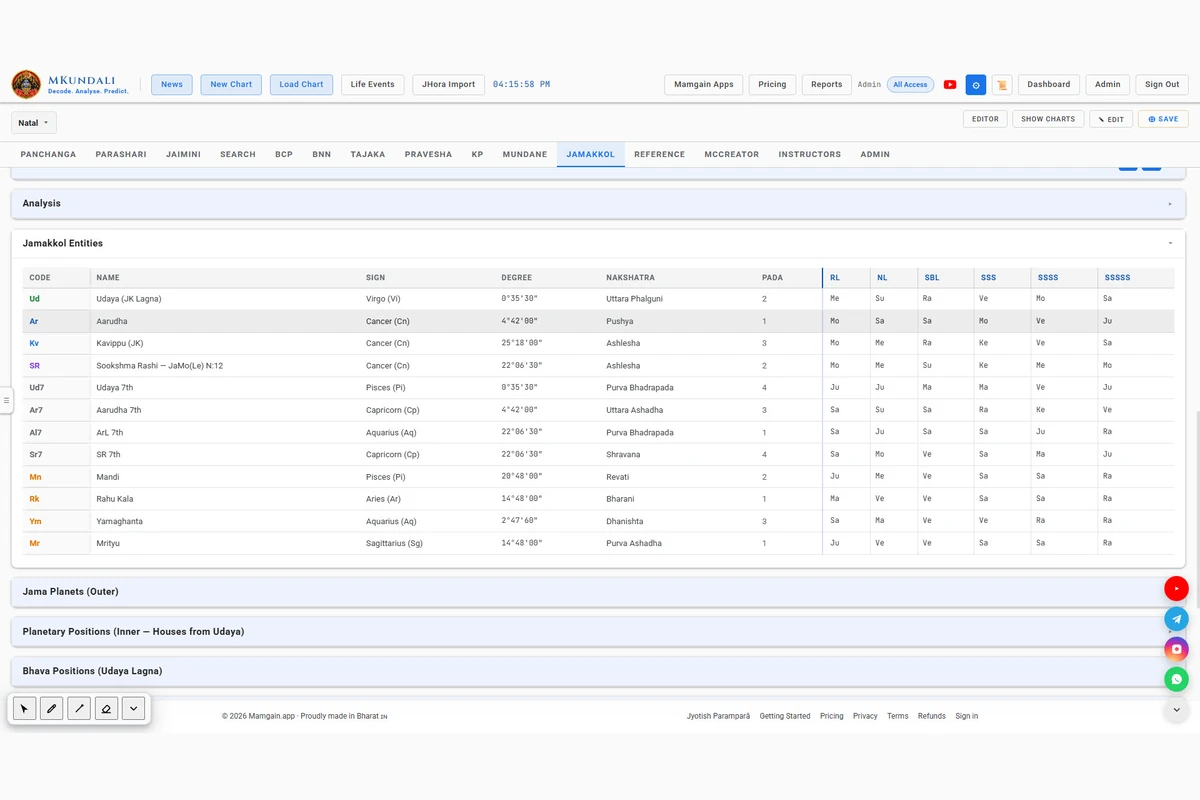
The Jamakkol Entities table lists the Jamakkol points and the Upagrahas with their sign, degree, Nakshatra, Pada and KP lords.

EntitiesMeaning
UdUdaya (JK Lagna)
ArAarudha
KvKavippu (JK)
SRSookshma Rashi Point
Ud7, Ar7, Al7, Sr7The seventh-point companions of Udaya, Aarudha, the Aarudha lord point and SR
Mn, Rk, Ym, MrMandi, Rahu Kala, Yamaghanta and Mrityu

Upagrahas

The four Upagrahas come from the shared Traditional Upagraha engine, the same one used by the Prashna workspace. Rahu Kala here is the Ardha Prahara.

KP lords are extra positional details for each entity.

Seventh-Point Companions

The seventh points are shown in the Entities table and in the Arc Distance Matrix. They are not drawn as chart markers.

MKundali Jamakkol Entities table with Udaya, Aarudha, Kavippu, SR and Upagrahas
Jamakkol Entities.

Component 5

Aarudha, Kavippu and Sookshma Rashi Point

Three derived points sit between the Udaya and the Jama Grahas. MKundali calculates each of them from the query moment.

Aarudha

MKundali calculates a time-derived Aarudha point using the birth-time minute and second information. It is a Jamakkol point, not a general Jaimini Arudha Pada.

Kavippu JK

Calculate Kavippu using the Sun-sign-based Veethi assignment, Aarudha and Udaya sign. Jamakkol Kavippu uses Udaya as the reference Lagna rather than the ordinary birth Lagna used by the shared Prashna Chhatra approach.

Sookshma Rashi Point

MKundali calculates a Sookshma Rashi Point using the Aarudha sign, its lord’s corresponding Jama Graha position and the Udaya sign.

  • Aarudha Lord
  • Jama position of the Aarudha Lord
  • Udaya-to-ArL count
  • SR sign and degree
  • Nakshatra and Pada
  • KP planetary divisions

Cyclic Direction

On the cyclic compound-degree string used by the Analysis section, the Jama Grahas and Kavippu move backward, and the other points move forward.

MKundali Jamakkol Aarudha, Kavippu and Sookshma Rashi Point
Aarudha, Kavippu and Sookshma Rashi Point.

Component 6

Analysis and Exchanges

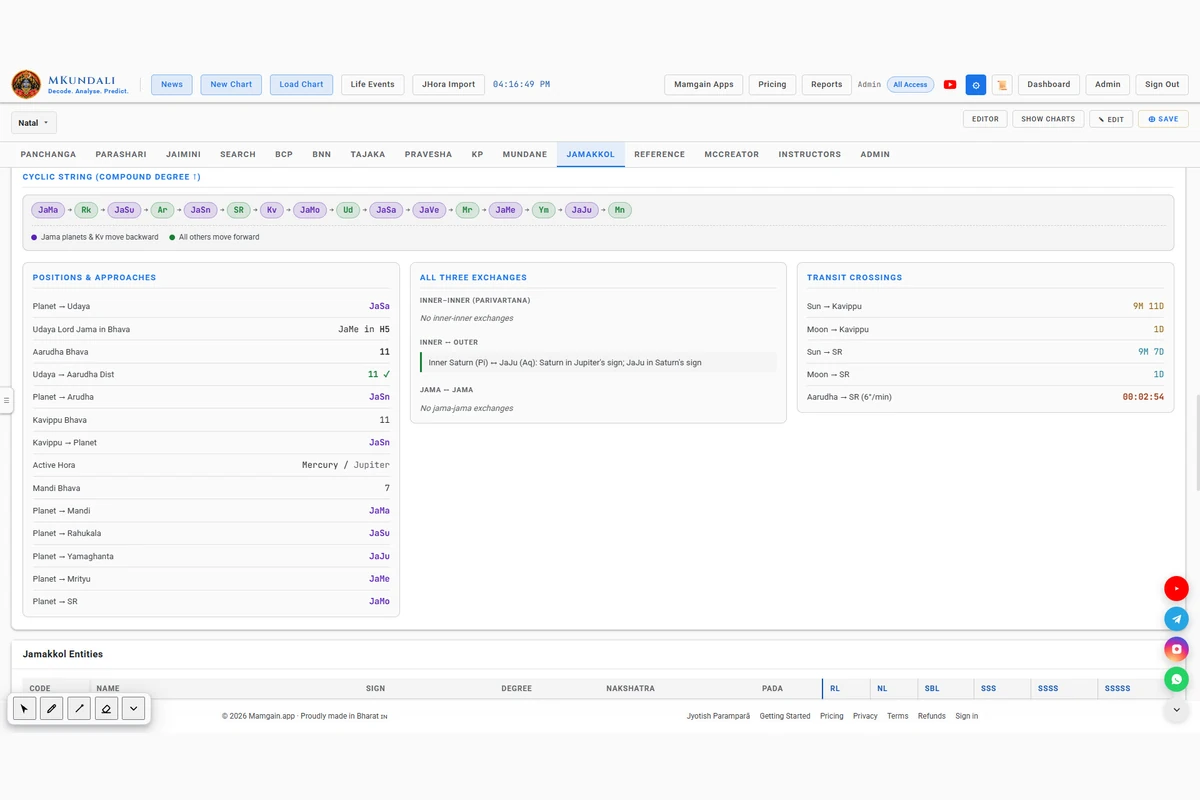
The Analysis section sits below the charts. It lays out the cyclic string, the positions and approaches, three kinds of exchange and the transit crossings.

Cyclic String

All the points are ordered by compound degree into one string. Jama Grahas and Kavippu are marked as moving backward; the others move forward.

Positions and Approaches

  • Planet → Udaya
  • Udaya Lord Jama in Bhava
  • Aarudha Bhava
  • Udaya → Aarudha distance
  • Planet → Arudha
  • Kavippu Bhava and Kavippu → Planet
  • Active Hora
  • Mandi Bhava
  • Planet → Mandi, Rahukala, Yamaghanta, Mrityu
  • Planet → SR

Houses 6, 8 and 12 are flagged for some rows, and houses 3 and 11 are marked favourable for the Udaya to Aarudha distance.

Three Exchanges

  • IInner–Inner (Parivartana)
  • OInner ↔ Outer
  • JJama ↔ Jama

Each type is listed separately. Snake is excluded from the exchanges.

Transit Crossings

  • Sun → Kavippu
  • Moon → Kavippu
  • Sun → SR
  • Moon → SR
  • Aarudha → SR

These are estimates. The Sun and Moon crossings use fixed average daily speeds, and the Aarudha to SR time uses a fixed 6° per minute. They are not exact crossing times.

MKundali Jamakkol Analysis with cyclic string, approaches, exchanges and transit crossings
Analysis and exchanges.

Component 7

Bhava Positions and Varga Bhava Positions

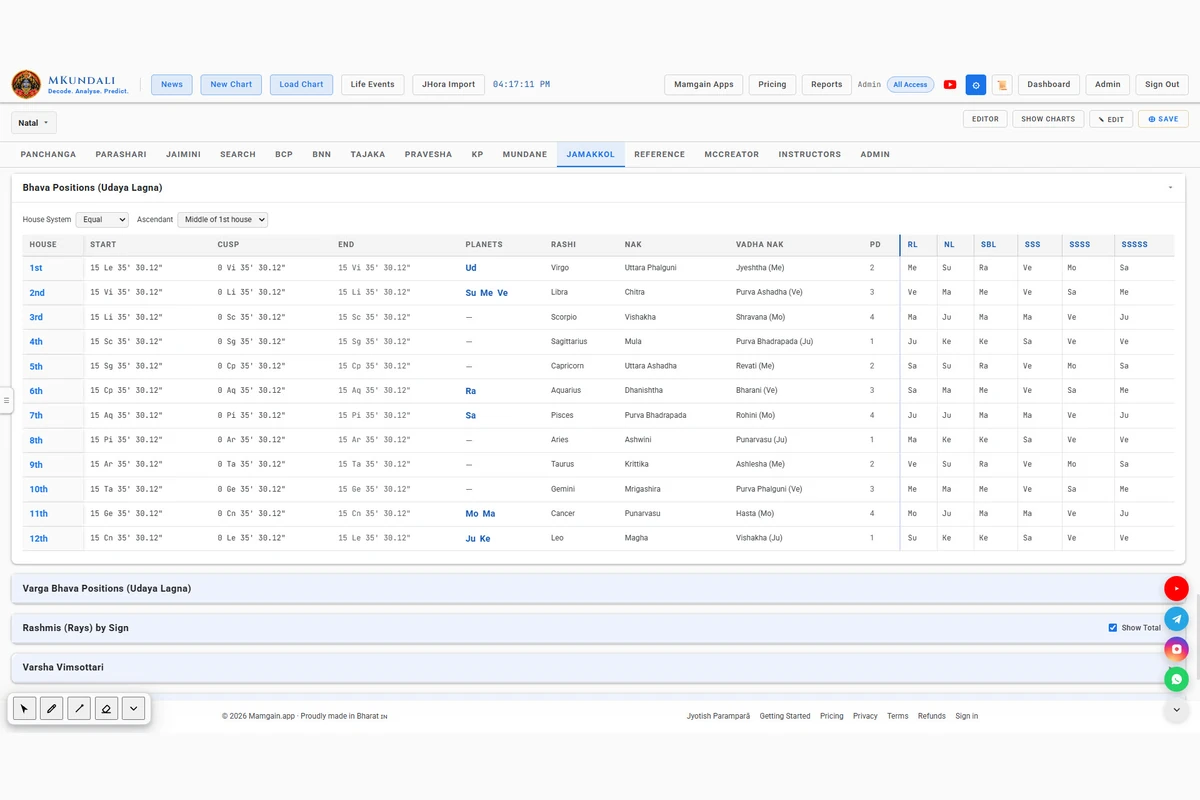
Two tables show the Bhava cusps measured from the Udaya Lagna, one for the main chart and one for a chosen divisional chart.

Bhava Positions

  • Equal house system (default)
  • Placidus
  • Sripati
  • Ascendant at the middle of the 1st house (default)
  • Ascendant at the start of the 1st house

The selection also updates the cusp markers on the Jamakkol charts.

Varga Bhava Positions

Choose a divisional chart from D2 through D144 and view the Bhava positions for it, with the same ascendant option. D9 is selected first.

Varga Bhava is a Jamakkol table on the selected divisional chart. It is not a separate Prashna or Parashari calculation.

MKundali Jamakkol Bhava Positions and Varga Bhava Positions
Bhava and Varga Bhava Positions.

Component 8

Rashmis – Ray Values by Sign

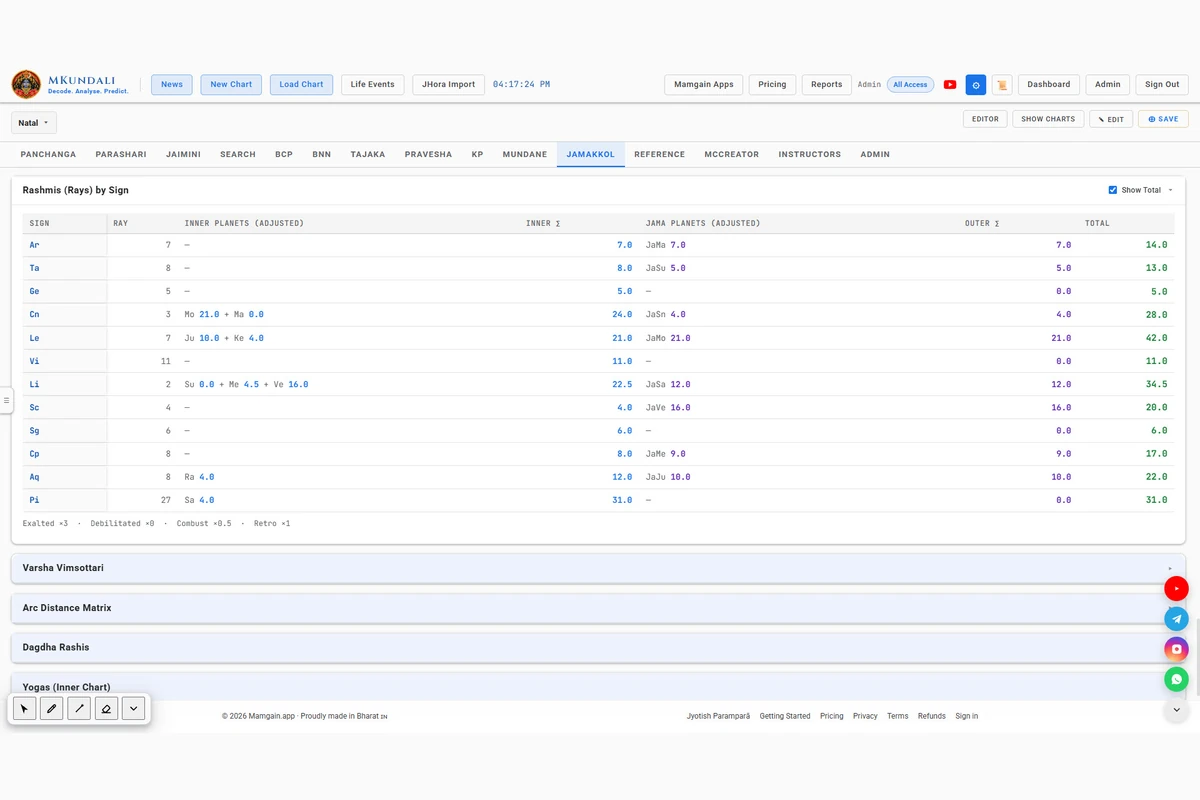
The Rashmis table gives each of the twelve signs a ray value, adds the rays of the planets in it, and shows inner and outer totals.

What the Table Shows

  • Sign and the sign ray
  • Inner planets, with their adjusted rays
  • Inner total
  • Jama planets, with their adjusted rays
  • Outer total
  • Combined Total column, when Show Total is on

The sign ray is counted once, in the inner total.

Ray Adjustments

  • Exaltation multiplier
  • Debilitation multiplier
  • Combustion multiplier
  • Retrograde multiplier

Combustion and retrograde apply to the inner planets only. The multipliers are shown beneath the table.

Preferences and Show Total

The ray values and the multipliers come from the existing Rashmi preferences in MKundali. Show Total Rashmis is a switch in the Options flyout.

Rashmis are a Jamakkol ray table. They are not Shadbala.

MKundali Jamakkol Rashmis table with inner and outer totals
The Rashmis table.

Component 9

Varsha Vimsottari

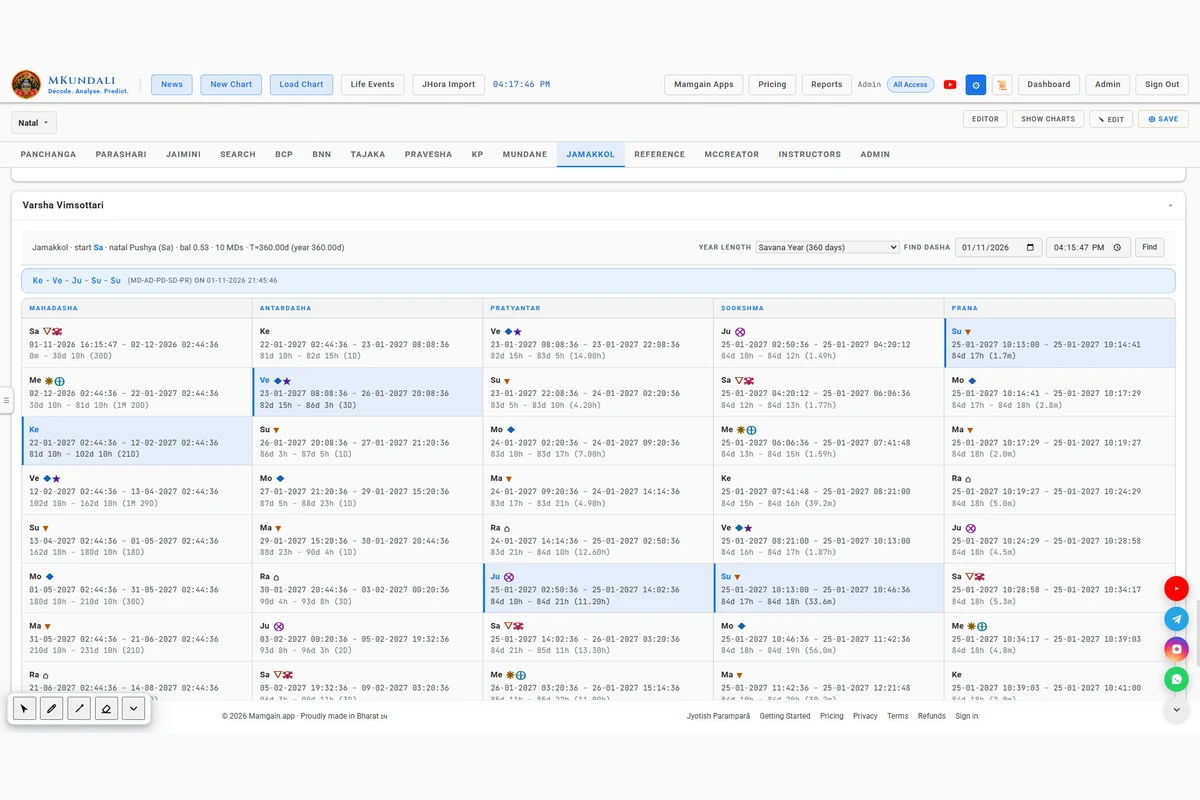
The Jamakkol workspace includes a Varsha Vimsottari browser, derived from the Mudda Dasa used for the annual cycle.

How It Works

The chart Moon sets the Dasha sequence, and the sequence runs from the chart moment, compressed into one Varsha year. It reuses the Mudda Dasa browser component that serves the annual Dasha views.

Year-Length Options

  • Savana Year, 360 days (default)
  • Mean Sidereal Solar Year
  • Mean Tropical Solar Year
  • True Tropical Solar Year
  • True Sidereal Solar Year
  • Year with 360 Tithis
  • User-Defined Year

Find Dasha

Enter a date and time and use Find to open the Dasha running at that moment. The Varsha year is counted from the chart date, and the browser shows the chain of periods for the selected date.

This is the Varsha Vimsottari browser only. It is not a separate full Dasha system.

MKundali Jamakkol Varsha Vimsottari browser with year-length options
Varsha Vimsottari.

Component 10

Arc Distance Matrix

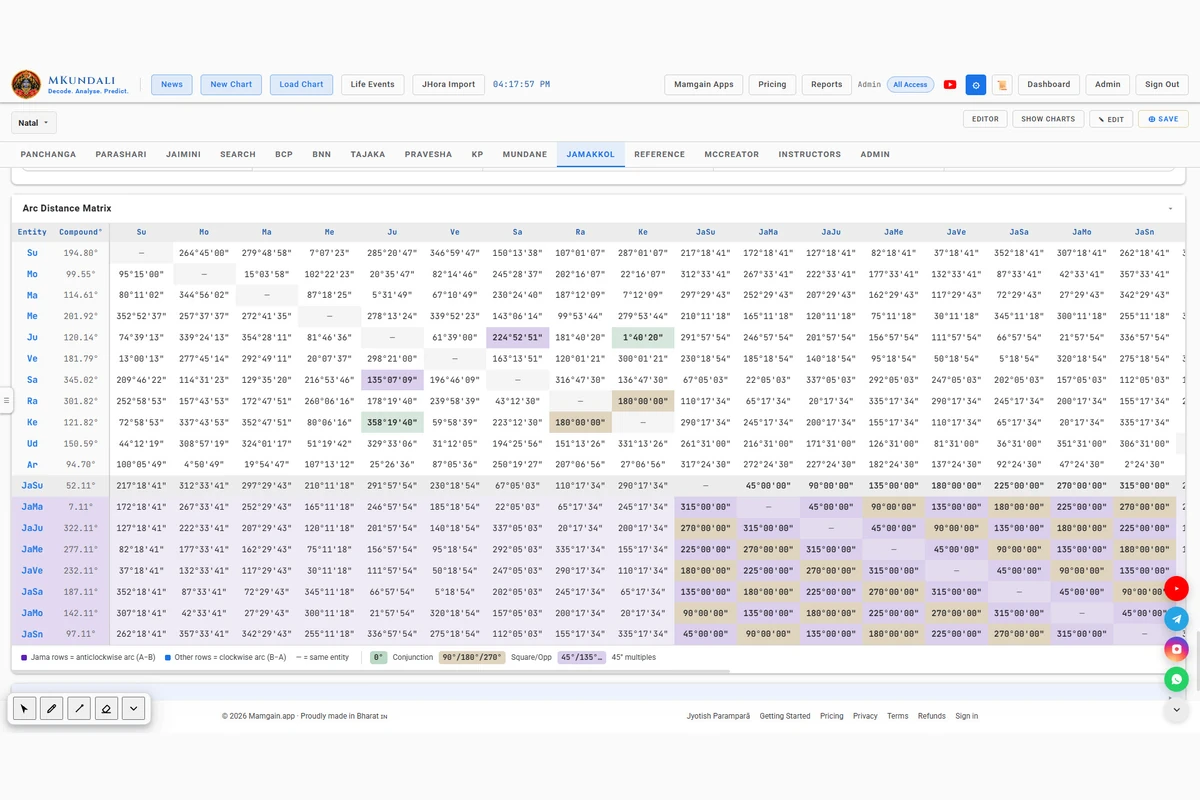
The Arc Distance Matrix measures the arc from each row entity to each column entity and prints it in degrees, minutes and seconds.

Rows and Columns

  • Rows: the nine inner planets, Udaya, Aarudha and the Jama Grahas
  • Columns: those same entities
  • Columns also include Ud7, Ar7, Arl7, SR, Sr7, Kv and the four Upagrahas

Direction

  • B−ANon-Jama rows: the clockwise arc
  • A−BJama rows: the anticlockwise arc

A dash marks an entity against itself.

Highlights

  • Same position
  • Near conjunction, within two degrees
  • 90°, 180° and 270° multiples
  • 45° multiples

The matrix highlights arcs. It is not an aspect engine.

MKundali Jamakkol Arc Distance Matrix
The Arc Distance Matrix.

Component 11

Dagdha Rashis

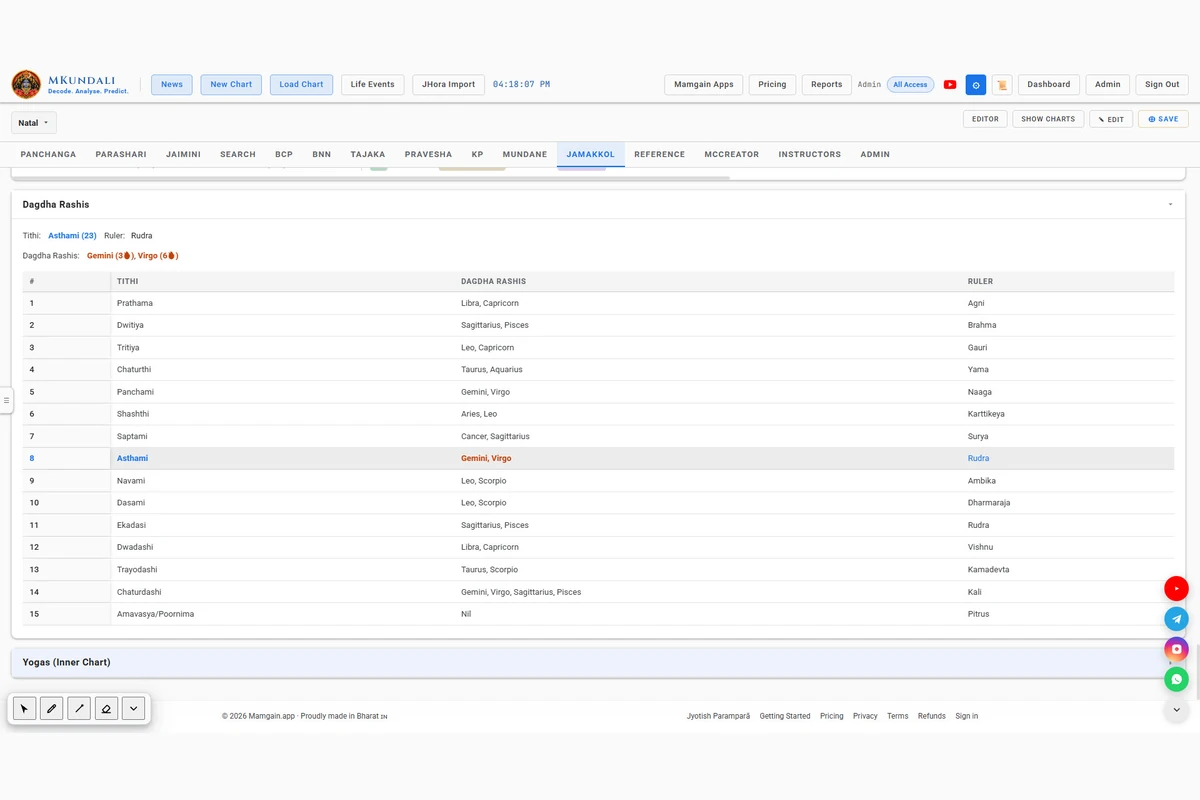
The Dagdha Rashis section identifies the signs associated with the chart’s Tithi.

What It Shows

  • The Tithi and its ruler
  • The Dagdha signs for that Tithi
  • A table of the Tithis, signs and rulers, with the current one highlighted
  • A fire marker on the Dagdha signs of the Jamakkol charts

This is the shared Tithi-based tool used elsewhere in MKundali. It makes no medical claims.

MKundali Jamakkol Dagdha Rashis section
Dagdha Rashis.

Component 12

Yogas – Examine the Inner Chart

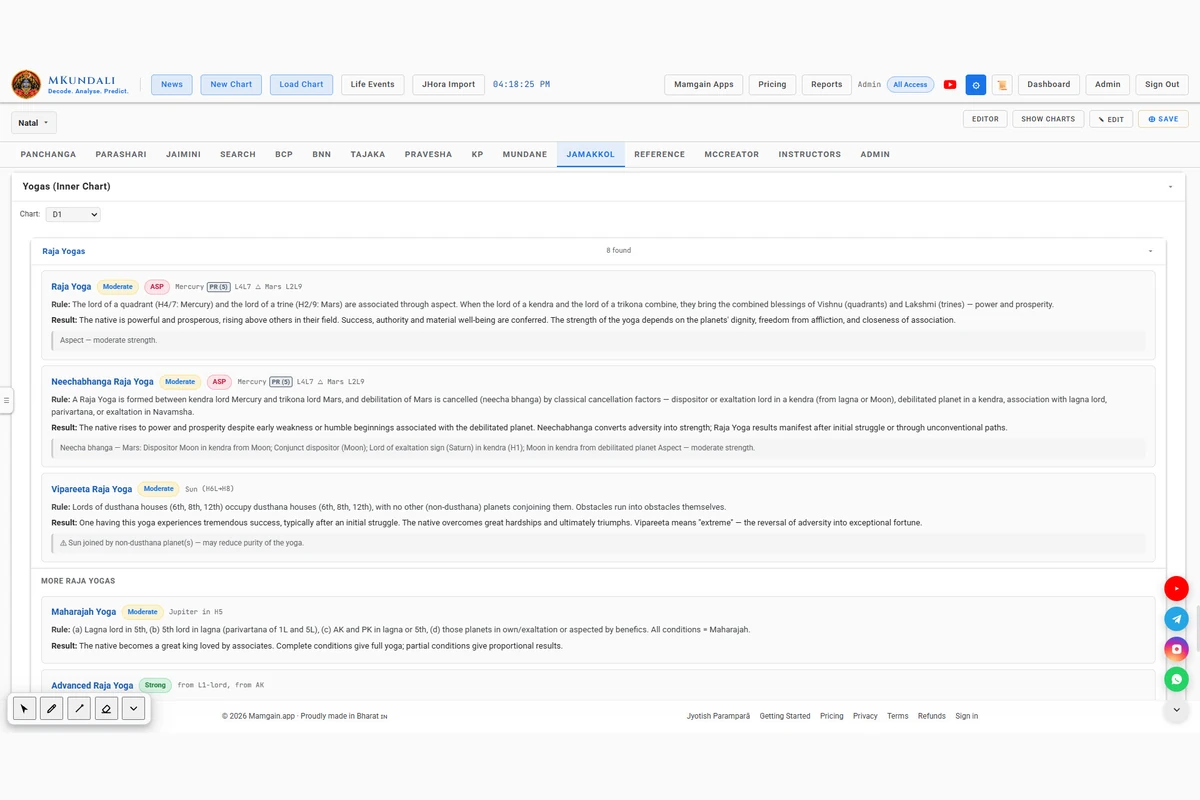
The Yogas section runs the shared Parashari yoga engine on the inner chart of the Jamakkol workspace.

Chart Selection

Choose D1 or a divisional chart from D2 through D144 and read the yogas for it.

The yoga engine is shared with the Parashari workspace. It is loaded when the section is first needed.

MKundali Jamakkol Yogas for the inner chart
Yogas for the inner chart.

Component 13

Reports and Printing

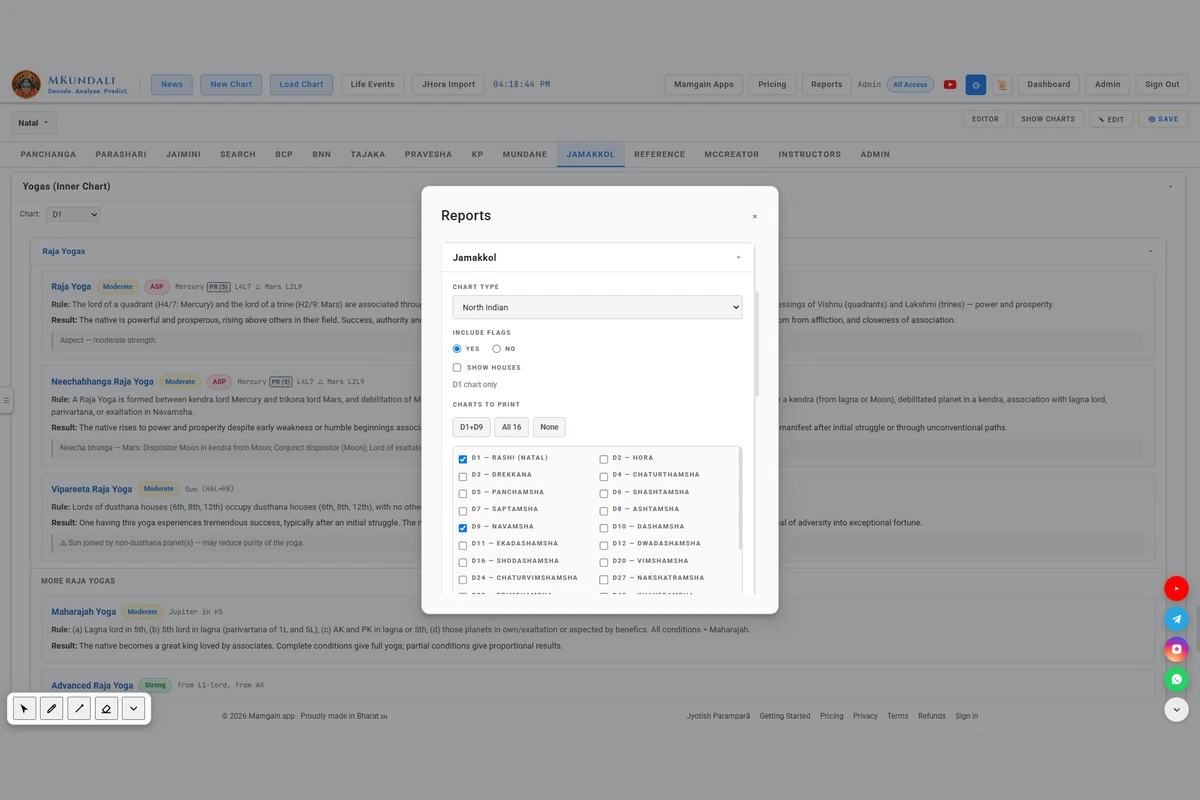
Jamakkol has its own card in the Reports dialog, with a preview and two print layouts.

Jamakkol Report

  • Chart style: North, South, East or Western
  • Flags on or off
  • Show Houses on the D1 chart
  • Charts to print: D1+D9, All 16 or None, or a custom selection
  • Pageless continuous layout, or a paged A4 report
  • Preview Report

The report carries the charts and the analytical tables: Analysis, Entities, Jama Planets, Planets, Rashmis and Varsha Vimsottari.

Print Individually or in Pairs

  • One chart in two different styles
  • Two charts in the same style
  • Jamakkol D1 includes the outer Jama layer
  • A strip of Udaya, inner planets and Jama Grahas
  • High-resolution PNG output
MKundali Reports dialog Jamakkol card with chart, flag and print options
The Jamakkol report options.

Why MKundali

A Connected Workspace for Jamakkol Prashna

Jamakkol work involves many linked positions. MKundali keeps them in one place, calculated from the same chart.

  • Udaya Lagna
  • Eight Jama Grahas
  • Aarudha
  • Kavippu
  • Sookshma Rashi Point
  • Four Upagrahas
  • Three exchange types
  • Bhava and Varga Bhava
  • Rashmis
  • Varsha Vimsottari
  • Arc Distance Matrix
  • Dagdha Rashis
  • Inner-chart Yogas
  • Reports and printing

MKundali provides calculation and analysis tools. It does not guarantee predictions, and interpretation remains with the astrologer. For other Prashna methods, see Parashari and KP.

FAQ

Frequently Asked Questions

What is Jamakkol Prashna?

Jamakkol Prashna is an astrological approach with its own Udaya calculation and Jama Graha positions. MKundali provides a dedicated workspace for these calculations and associated entities.

What is Udaya Lagna?

Udaya, also known as Jamakkol Lagna, is calculated using the Sun’s longitude, the birth time and the duration of daytime or nighttime.

What are Jama Grahas?

Jama Grahas are eight outer planetary positions calculated through an eightfold division of daytime or nighttime and a weekday-dependent planetary sequence.

Which planets are included in the Jama sequence?

Sun, Moon, Mars, Mercury, Jupiter, Venus, Saturn and Snake.

What is the difference between Udaya and the ordinary Lagna?

Udaya is calculated through the Jamakkol-specific day/night and Sun-longitude method. It is used as the reference Lagna for the Jamakkol chart and associated house analysis.

What is Kavippu JK?

Kavippu JK is a special point calculated using the Sun-sign-based Veethi assignment, Aarudha and Udaya. The Jamakkol implementation uses Udaya as its reference Lagna.

Does MKundali calculate Aarudha?

Yes. The Jamakkol workspace calculates a time-derived Aarudha point and displays its sign, degree and associated Nakshatra information.

What is the Sookshma Rashi Point?

It is a derived point calculated using the Aarudha, Aarudha Lord’s Jama Graha and Udaya-based sign count.

Does MKundali identify planetary exchanges?

Yes. It identifies Inner–Inner, Inner–Outer and Jama–Jama exchange relationships through the implemented sign-lord conditions.

Does MKundali provide Bhava Positions from Udaya?

Yes. It provides Bhava Positions and Varga Bhava Positions using the selected house system and Udaya reference.

What are Rashmis in Jamakkol?

Rashmis is a dedicated table showing configured sign rays and the adjusted contributions of inner planets and Jama Grahas.

Does MKundali include Dasha analysis for Jamakkol?

Yes. The workspace provides Varsha Vimsottari using the implemented Mudda Dasa calculation and year-length preferences.

Are all Jamakkol features available under every subscription?

Access to individual tools may depend on subscription plans and entitlements. Refer to the Pricing page for current availability.

Explore Jamakkol Prashna with MKundali

Examine Udaya Lagna, Jama Grahas, Aarudha, Kavippu, Sookshma Rashi Point, planetary exchanges and specialised analytical tools through one integrated workspace.