
Explore Vrishchika Rashi (Scorpio) in Vedic astrology, including its ruling planet Mars, water element, nakshatras, personality traits, emotional intensity, hidden knowledge, strengths, challenges, and career associations.
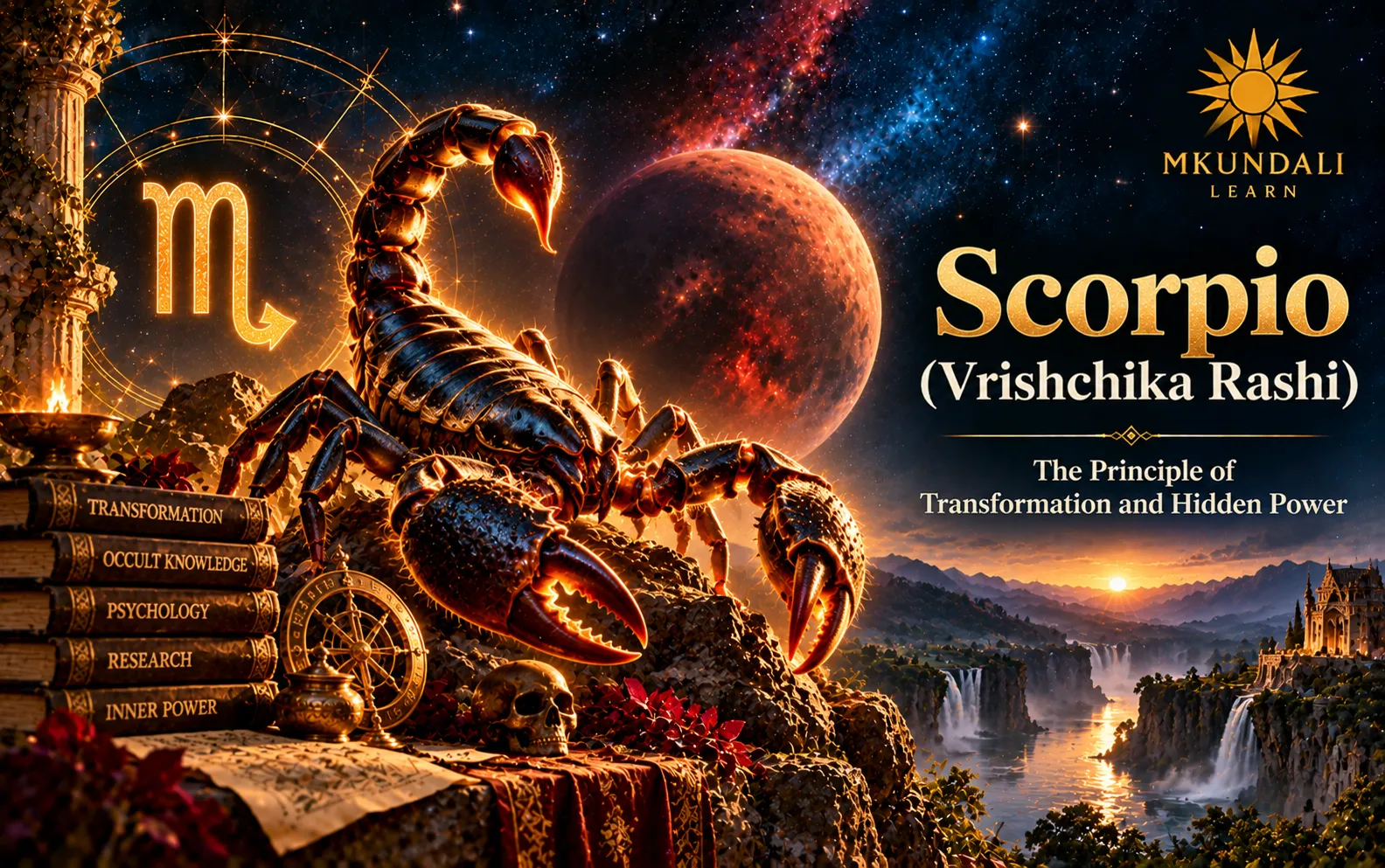
Scorpio (Vrishchika Rashi): The Principle of Transformation and Hidden Power
Scorpio, known as Vrishchika Rashi (वृश्चिक राशि) in Vedic astrology, is the eighth sign of the zodiac. It represents transformation, secrecy, emotional intensity, survival, hidden knowledge, and the ability to overcome difficult circumstances. Following the harmony and cooperation of Libra, Scorpio introduces deeper experiences involving vulnerability, power, attachment, and regeneration.
Ruled by Mars (Mangal), Scorpio expresses determination, courage, strategic thinking, and the instinct to confront challenges. Its Water element (Jala Tattva) emphasizes emotional depth and intuition, while its fixed modality (Sthira) provides persistence, endurance, and resistance to external pressure.
Scorpio is associated with the ability to investigate what remains concealed, confront uncomfortable realities, and emerge stronger through transformation. Its strengths include resilience, loyalty, and psychological insight. Its challenges may include suspicion, possessiveness, secrecy, and excessive emotional intensity.
Core Attributes of Vrishchika Rashi
The traditional attributes of Scorpio provide a foundation for understanding its nature and significance in Vedic astrology.
- Sanskrit Name: Vrishchika Rashi (वृश्चिक राशि)
- Zodiac Position: Eighth sign of the zodiac
- Element (Tattva): Water (Jala) — emotional depth, intuition, sensitivity, and transformation
- Modality (Gati): Fixed (Sthira) — persistence, determination, and endurance
- Direction (Disha): North
- Ruling Planet (Swami): Mars (Mangal) — courage, willpower, action, and survival instincts
- Additional Traditional Association: Ketu — linked with detachment, hidden knowledge, and spiritual transformation in certain Nadi traditions
- Body Parts (Kaya Bhaga): Genitals and reproductive organs — traditionally associated with regeneration and reproduction
- Gender: Female — receptivity, intuition, and inwardly directed energy
- Varna: Shudra — service, resilience, and practical effort
- Guna: Tamas — depth, concealment, persistence, and attachment
- Sign Nature (Prakriti): Cold and moist — traditionally associated with emotional intensity and receptivity
- Animal Symbol: Scorpion — protection, secrecy, precision, and defensive strength
Together, these attributes establish Scorpio as a sign of transformation, emotional depth, secrecy, and regenerative power.
Mars: The Ruling Planet of Scorpio
Mars governs Scorpio and contributes its associations with courage, determination, physical energy, conflict, and survival. Unlike Aries, where Mars expresses itself through direct action and outward initiative, Scorpio directs much of this energy toward strategic action, emotional endurance, and the management of hidden or complex situations.
Under a constructive expression, Scorpio may indicate courage under pressure, strong investigative ability, persistence, and the capacity to overcome adversity. Its fixed nature can support sustained effort even when circumstances are difficult.
When expressed poorly, these qualities may become suspicion, jealousy, resentment, secrecy, or a desire to control situations and relationships.
In classical Parashari astrology, Mars is the ruler of Scorpio. Certain Nadi traditions also associate Ketu with Scorpio, emphasizing detachment, occult knowledge, and spiritual transformation. However, Ketu's additional association should not be confused with the primary sign rulership of Mars.
The condition of Mars in the birth chart helps determine how Scorpio's qualities are expressed.
Nakshatras in Vrishchika Rashi
Scorpio contains portions of three nakshatras: Vishakha, Anuradha, and Jyeshtha. Each contributes a distinct influence to the sign.
Vishakha Nakshatra (20° Libra–3°20′ Scorpio)
Vishakha begins in Libra and extends into Scorpio. It is associated with ambition, determination, focused effort, and the pursuit of specific goals. In Scorpio, these qualities may become more intense, strengthening persistence and the willingness to overcome obstacles.
Anuradha Nakshatra (3°20′–16°40′ Scorpio)
Anuradha is associated with friendship, devotion, loyalty, discipline, and cooperation. Its influence can moderate Scorpio's intensity by directing emotional commitment toward meaningful relationships and shared objectives.
Anuradha also emphasizes the ability to maintain relationships through difficulties, combining emotional depth with dedication and perseverance.
Jyeshtha Nakshatra (16°40′–30° Scorpio)
Jyeshtha is associated with authority, seniority, protection, responsibility, and the management of difficult situations. Its influence can strengthen strategic thinking, independence, and the desire to maintain control over one's circumstances.
When expressed constructively, it supports responsible leadership and protection. Under difficult influences, it may increase suspicion, competitiveness, or concern with status and authority.
Together, these nakshatras describe a progression from focused ambition through devoted commitment to responsibility, protection, and inner mastery.
Personality and Psychological Characteristics
Scorpio is traditionally associated with an intense, perceptive, and emotionally resilient temperament. It seeks to understand the deeper motivations behind events and relationships, often preferring substance over superficial appearances.
Share this article
0 likes · 0 comments
Comments
No comments yet.
Leave a comment
Comments are checked by an admin before they appear. Your email is never shown.