MKundali Decode. Analyse. Predict.

Tajaka workspace

Tajaka Astrology Software for Annual and Periodic Horoscope Analysis

Explore Varsha Pravesh, Maasa Pravesh, Shashti-hora, Muntha, Sahams, Tajaka aspects, planetary strengths and traditional timing systems through MKundali.

MKundali provides a dedicated Tajaka workspace that extends beyond the annual solar-return chart. Examine annual and monthly charts, 60-hour divisions and nested sub-hora charts, supported divisional charts, special points, planetary strengths, Tajaka Yogas and annual Dasha systems within one integrated environment.

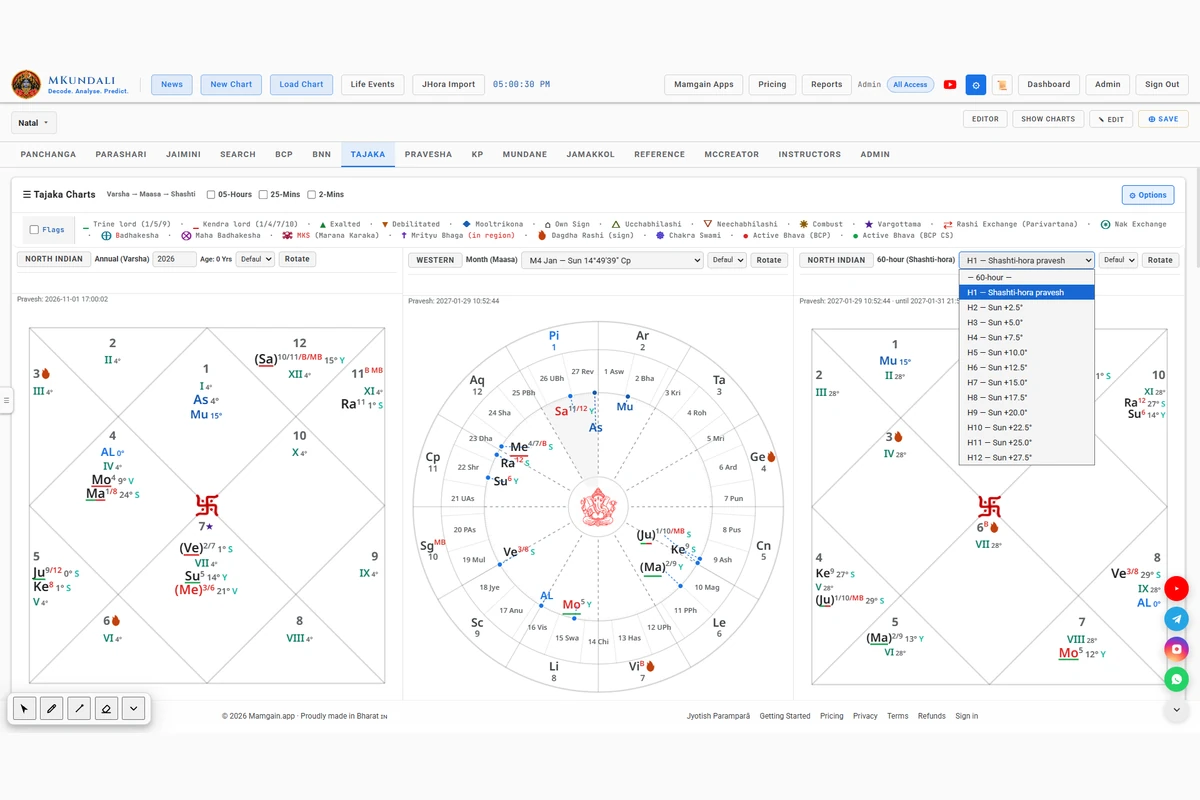
MKundali Tajaka workspace with the Varsha Pravesh annual chart

Workspace overview

One Tajaka Workspace, Sixteen Analytical Components

The Tajaka tab works through six nested chart levels: Annual (Varsha), Month (Maasa), 60-hour (Shashti-hora), 05-Hours, 25-Mins and 2-Mins. Every analytical card below the charts, from Planetary Positions to the Dasa systems, works on the Tajaka chart you select.

  1. 1Varsha PraveshExact annual solar return
  2. 2Maasa PraveshTwelve monthly charts
  3. 3Shashti-horaTwelve 60-hour charts a month
  4. 4Sub-hora05-Hours, 25-Mins, 2-Mins
  5. 5Divisional ChartsVargas of each level
  6. 6Fusion ChartsSix slots, inner and outer
  7. 7Planetary PositionsTable for any level
  8. 8MunthaTwo methods, house quality
  9. 9Lords of Year and MonthCandidates and selection
  10. 10SahamsThirty-six sensitive points
  11. 11Tajaka AspectsDeeptamsa orbs and strength
  12. 12Tajaka BalasHarsha, Pancha, Dwaadasa
  13. 13Tajaka YogasSixteen implemented Yogas
  14. 14Patyayini DasaAnnual planetary periods
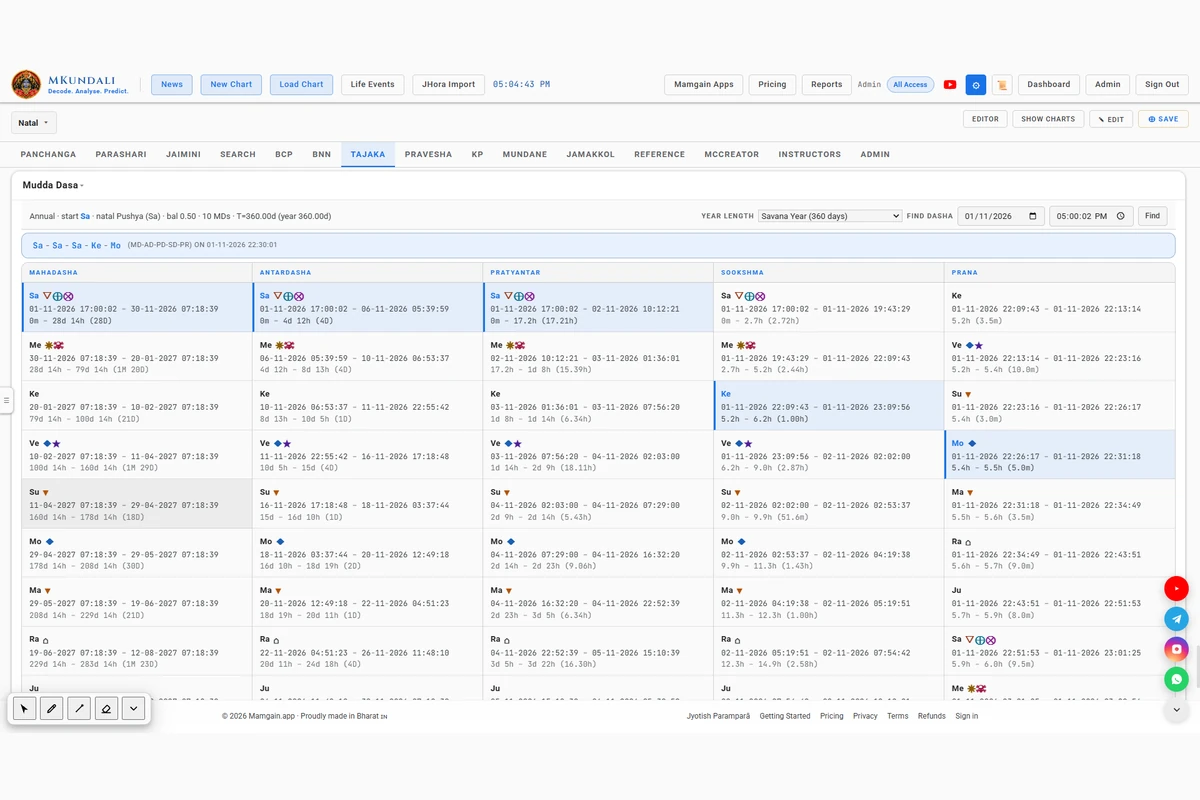
  15. 15Mudda DasaVarsha Vimshottari
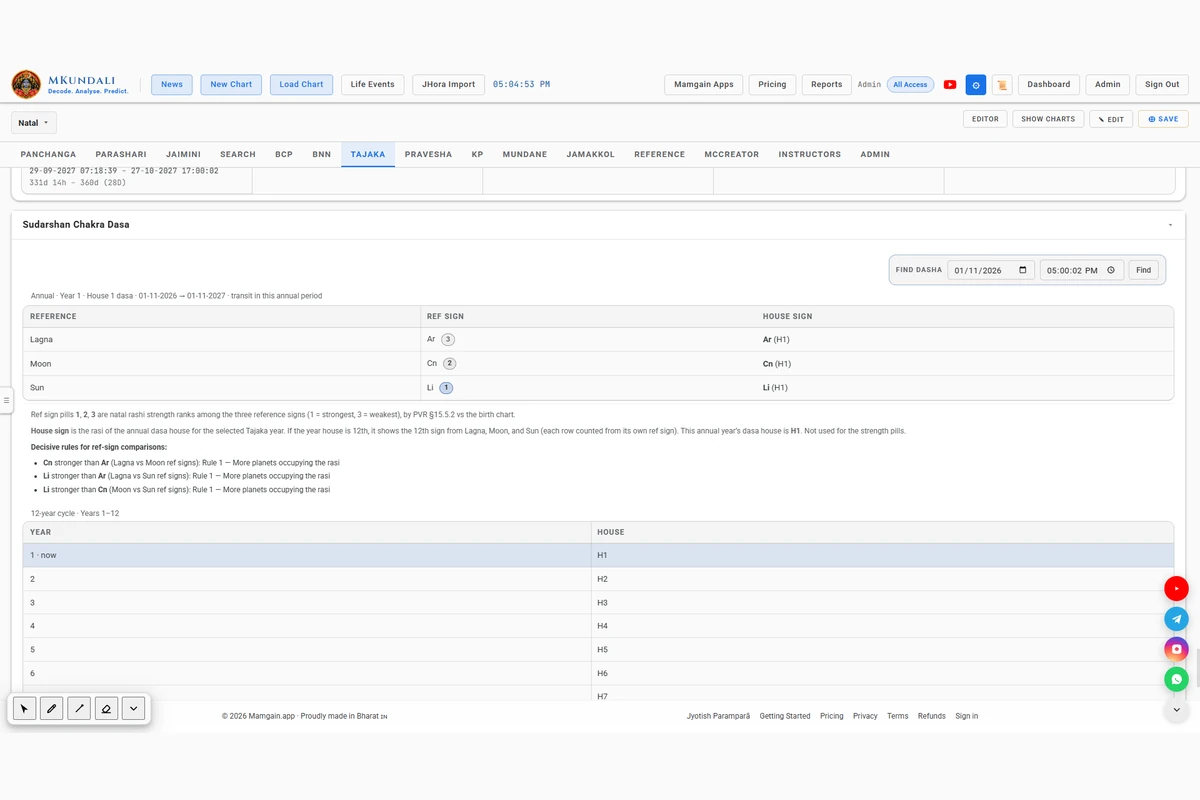
  16. 16Sudarshan Chakra DasaAnnual house cycle

Some tools may be restricted to certain subscription plans. See the Pricing page for current availability.

Section 1 of 16

Varsha Pravesh – Calculate the Annual Tajaka Chart

Varsha Pravesh is the foundation of Tajaka annual chart analysis. MKundali calculates the annual Pravesh moment when the Sun returns to the exact natal sidereal longitude.

Exact Annual Pravesh

The annual return is calculated from the Sun's exact natal sidereal longitude, including degree, minute and second.

  • Natal Sun sidereal longitude as the reference
  • Exact solar-return moment
  • Birth latitude and longitude retained
  • Rasi and divisional charts for that instant

Approximate Annual Pravesh

The calculation engine also has an optional approximate method. It adds the sidereal solar-year excess over 364 days (1 day 6 hours 9 minutes 12 seconds per completed year), using the implemented Table 71 and a sunrise-based weekday adjustment.

The Tajaka tab uses the exact method. The approximate method is not the default, and it is not used for Maasa Pravesh or Shashti-hora charts.

Annual Chart Details

Examine the annual chart through the standard and divisional chart views, Planetary Positions, Muntha, Tajaka aspects, Balas and Yogas. The Annual chart is also the base for Patyayini, Mudda and Sudarshan Chakra Dasa.

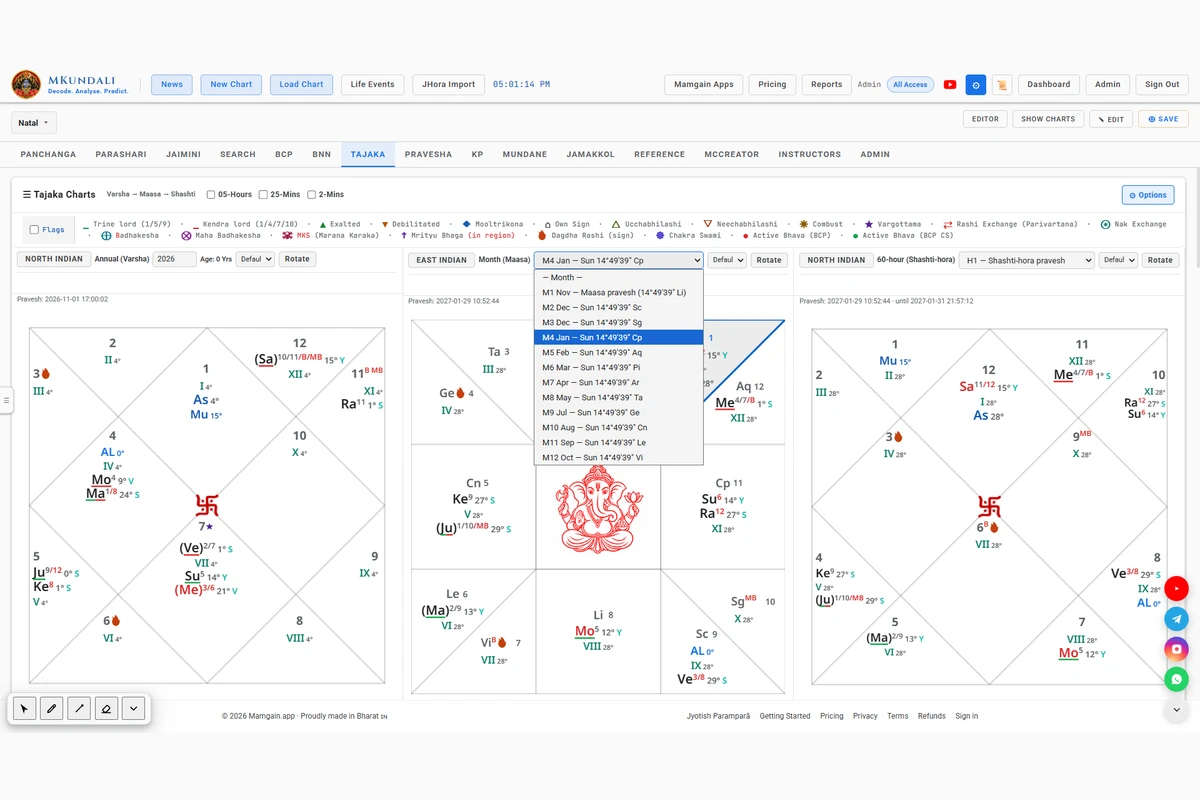
MKundali Tajaka workspace with the Varsha Pravesh annual chart
Varsha Pravesh: the annual Tajaka chart.

Section 2 of 16

Maasa Pravesh – Explore Twelve Monthly Charts

MKundali calculates twelve Maasa Pravesh charts within a Tajaka year using successive 30-degree movements of the Sun from the natal solar-return longitude.

How the Months Work

  • 12Twelve months per Tajaka year
  • 1Month 1 begins at Varsha Pravesh
  • 30°Each next month advances the Sun by 30 degrees
  • The next Maasa Pravesh comes from the exact solar crossing

Same Birth Location

Monthly charts are calculated for the birth place, like the annual chart. Use them to examine changes through the annual Tajaka cycle.

These are solar months of 30 degrees, not Gregorian calendar months. Maasa Pravesh has no approximate calculation method.

MKundali Tajaka Maasa Pravesh monthly chart
Maasa Pravesh: a monthly Tajaka chart.

Section 3 of 16

Shashti-hora – Examine Twelve 60-Hour Periods per Month

Each Maasa Pravesh is further divided into twelve Shashti-hora periods, each covering 60 hours or 2.5 days.

Structure

  • Twelve 60-hour periods per month
  • 2°30′ of solar movement each
  • Hora 1 begins at the Maasa Pravesh
  • 144 charts in a Tajaka year

Exact Solar Progression

Each later Hora is found by moving the Sun a further 2°30′ from the start of the month, using the exact solar crossing at the birth place.

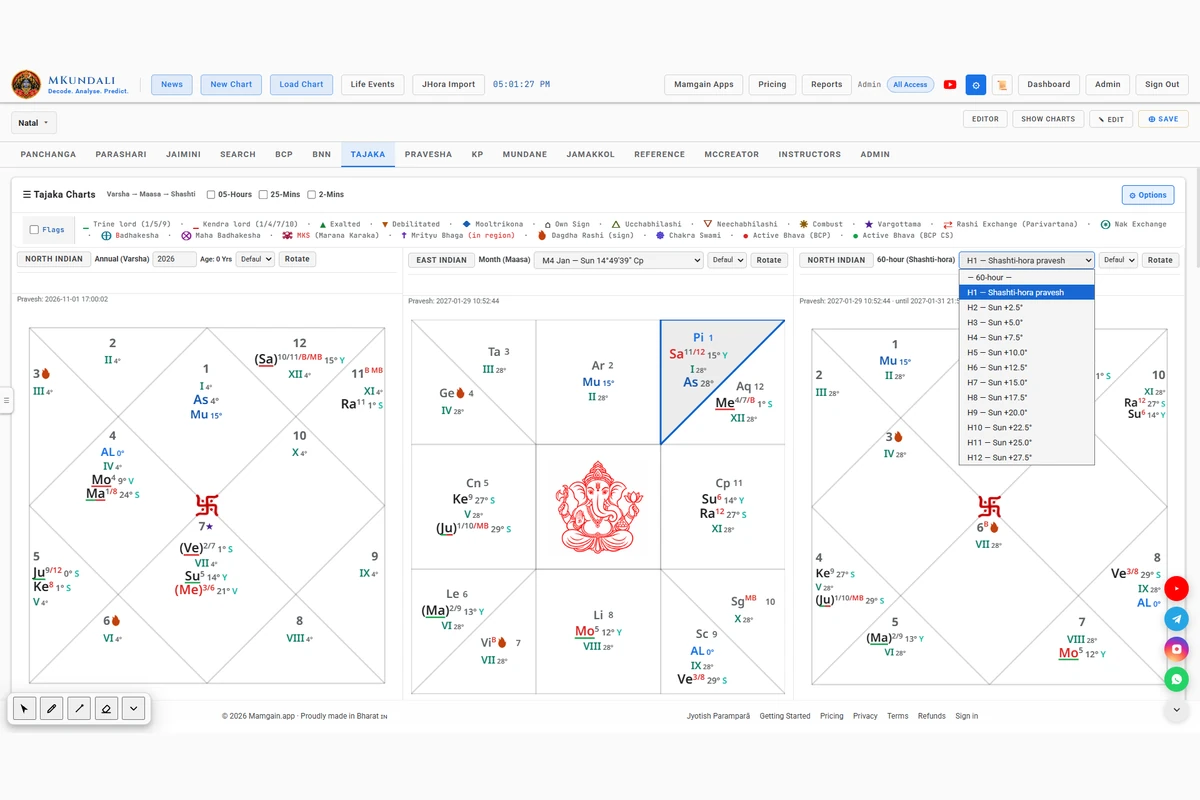
Examine each 60-hour chart as a shorter-period Tajaka chart derived from the monthly solar-return sequence.

MKundali Tajaka Shashti-hora 60-hour chart
Shashti-hora: a 60-hour Tajaka chart.

Section 4 of 16

Sub-hora – Examine Shorter Tajaka Time Divisions

MKundali further subdivides the 60-hour Tajaka period into three nested chart levels. Each child level is produced by dividing the parent's solar arc into twelve equal parts.

05-Hours

Each 60-hour period is divided into twelve equal solar-arc subdivisions, producing twelve 05-Hour Pravesha charts. Each step is 12′30″ of solar movement.

25-Mins

Each 05-Hour period is divided into twelve further subdivisions, producing the 25-Minute chart level.

2-Mins

Each 25-Minute period is divided into twelve further subdivisions, producing the final 2-Mins level.

Hierarchical Structure

Varsha Pravesh
    └── 12 Maasa Pravesh charts
          └── 12 Shashti-hora charts per month
                └── 12 × 05-Hours divisions
                      └── 12 × 25-Mins divisions
                            └── 12 × 2-Mins divisions

The sub-hora levels are not independent arbitrary time slices. Each one is an exact twelve-way split of its parent's solar arc, found by the same exact Sun-crossing method at the birth place.

The label “2-Mins” stands for an exact twelve-way solar division of the parent interval. Its duration is about 2.083 minutes, not a fixed two-minute clock interval.

Navigation

Use the chart selectors to move between the annual, monthly, 60-hour and nested sub-hora charts. Each level's selector is filled once its parent level is chosen. The 05-Hours, 25-Mins and 2-Mins charts are optional: switch each on or off with its own checkbox in the Tajaka Charts bar, and all three are off by default.

MKundali Tajaka sub-hora charts at 05-Hours, 25-Mins and 2-Mins levels
Sub-hora: 05-Hours, 25-Mins and 2-Mins charts.

Section 5 of 16

Tajaka Divisional Charts – Examine Vargas at Different Pravesh Levels

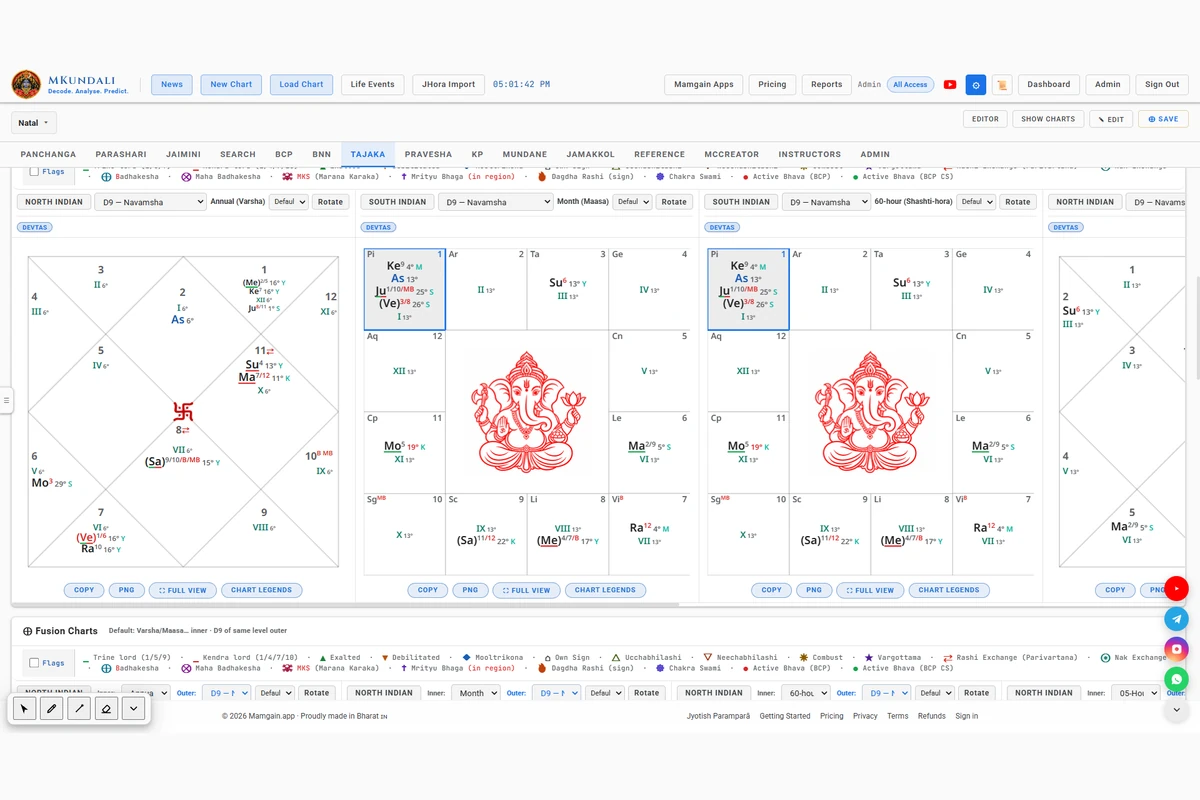
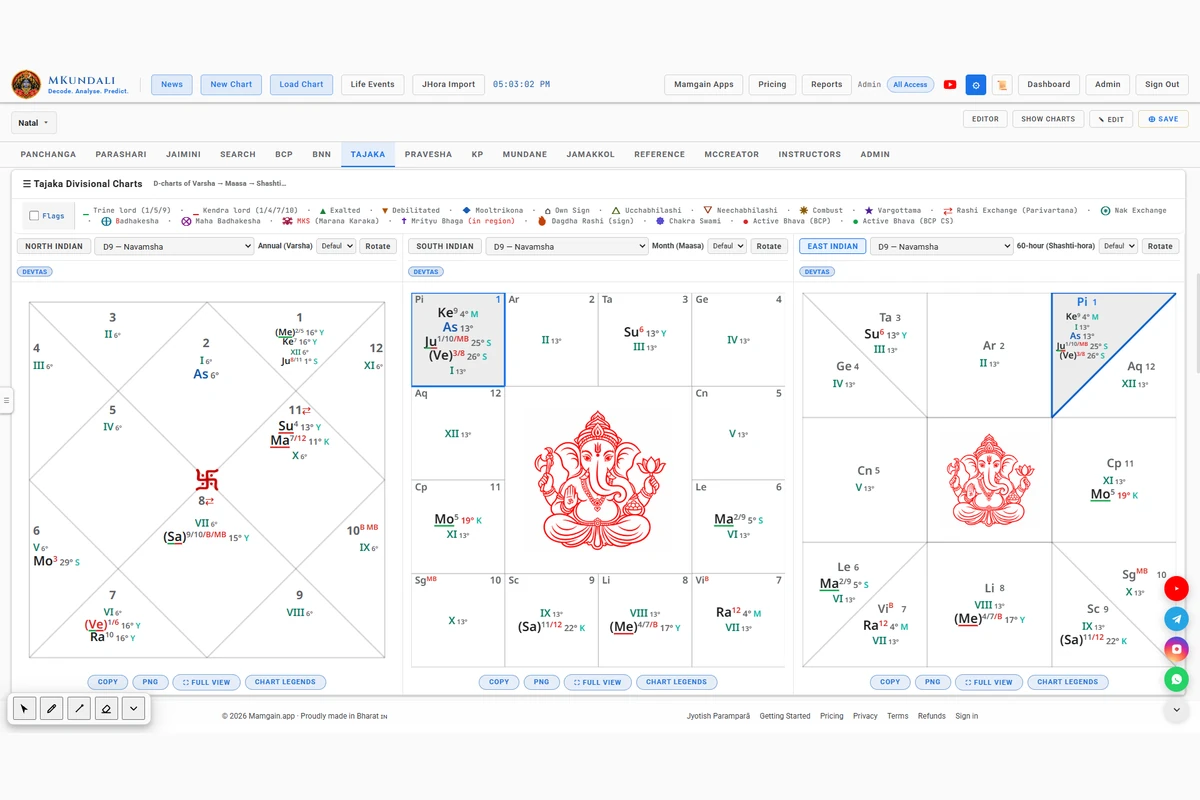
MKundali provides divisional chart views derived from selected Tajaka Pravesh charts, in a Tajaka Divisional Charts card with one slot for each level.

Levels

  • Annual
  • Month
  • 60-hour
  • 05-Hours
  • 25-Mins
  • 2-Mins

The sub-hora slots appear when their checkboxes are on.

Controls

  • Varga selection per slot
  • Chart style selection
  • Chart rotation
  • Chart Options

Each slot starts at D9 and can be changed to another supported varga.

Divisional views are built from the data of the corresponding Tajaka base chart. They do not use a separate Pravesh algorithm for each varga.

MKundali Tajaka Divisional Charts for each Pravesh level
Tajaka Divisional Charts for each Pravesh level.

Section 6 of 16

Fusion Charts – Compare Tajaka Chart Levels Together

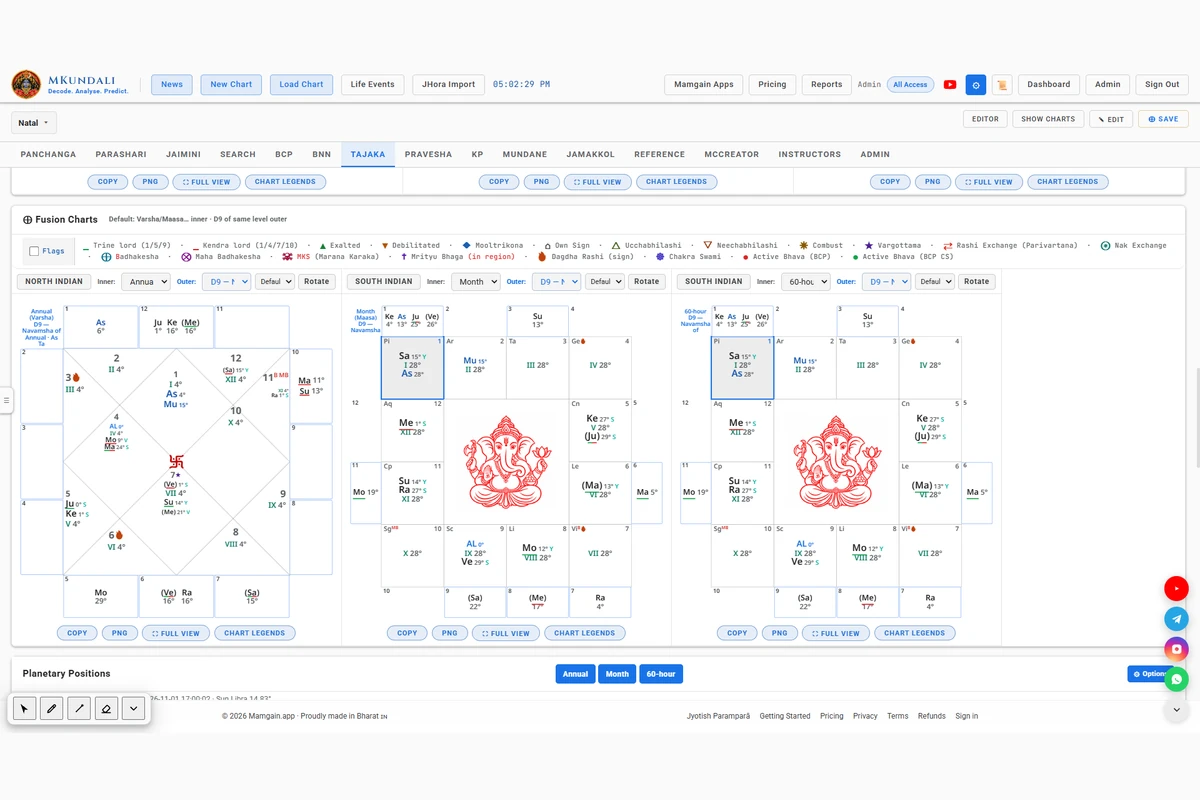
MKundali provides six Fusion Chart slots to combine selected Tajaka chart levels and divisional charts in the same visual arrangement.

Default Fusion Arrangement

  • 1Annual chart with D9 of the Annual chart
  • 2Month chart with D9 of the Month chart
  • 360-hour with D9 of the 60-hour chart
  • 405-Hours with D9 of 05-Hours
  • 525-Mins with D9 of 25-Mins
  • 62-Mins with D9 of 2-Mins

Configurable Inner and Outer Charts

Select the inner and outer chart sources independently. The selector supports:

  • Natal
  • Annual
  • Month
  • 60-hour
  • 05-Hours
  • 25-Mins
  • 2-Mins
  • Divisional charts D2 to D144

A divisional choice is worked out from the other ring's chart when that is a chart level. Otherwise it uses this slot's own Tajaka level.

Special Chart Overlays

  • Muntha (Mu) on the outer ring
  • Divisional Ascendant marker (As)
  • Tajaka aspect arrows

Muntha appears on the outer ring when the selected outer chart is a Tajaka Pravesh level. It does not appear for a Natal or divisional outer chart. A divisional outer layer shows the divisional Ascendant marker. Tajaka aspect arrows appear when the selected chart carries Tajaka aspect data.

These overlays do not apply identically to every inner and outer combination.

MKundali Tajaka Fusion Charts with inner and outer chart layers
Tajaka Fusion Charts: inner and outer layers.

Section 7 of 16

Planetary Positions – Examine the Selected Tajaka Chart

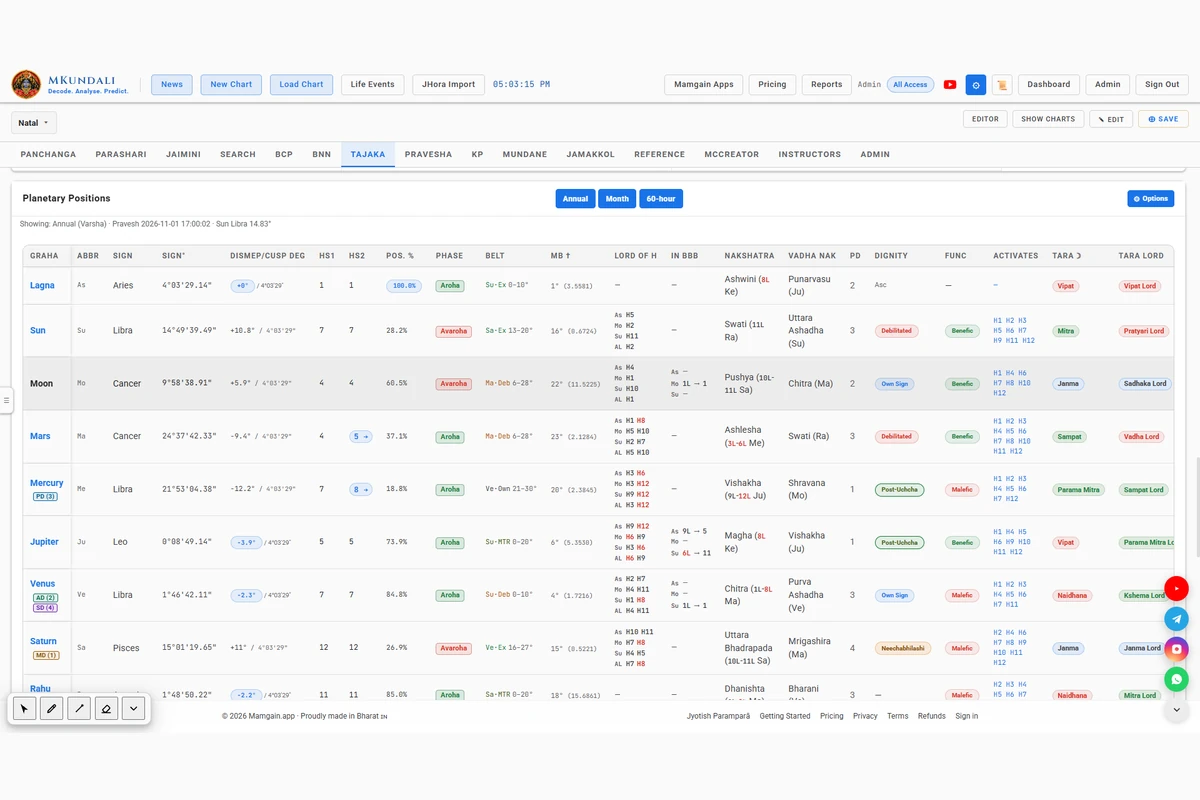
MKundali provides a detailed Planetary Positions table for the selected Tajaka level.

Source Selector

  • Annual
  • Month
  • 60-hour
  • 05-Hours
  • 25-Mins
  • 2-Mins

Configurable Columns

The table can show the following information where it applies:

  • Graha and abbreviation
  • Sign and degree
  • DISMEP/Cusp degree
  • Whole-sign house
  • Bhava house
  • Positional percentage
  • Aroha/Avaroha phase
  • Belt
  • Mrityu Bhaga
  • House lordships
  • Bhavat Bhavam
  • Nakshatra and pada
  • Vadha Nakshatra
  • Dignity
  • Functional nature
  • Activates
  • Navtara and Tara Lord
  • Daily motion
  • Latitude
  • Tropical longitude
  • Kranti
  • KP Rashi, Nakshatra and Sub Lords
  • Deeper KP divisions
  • Planetary flags

Use the column Options control to choose what the table shows. No column is mandatory or permanently displayed.

MKundali Tajaka Planetary Positions table with the Annual to 2-Mins source selector
Planetary Positions for the selected Tajaka level.

Section 8 of 16

Muntha – Examine the Annual Progression of Lagna

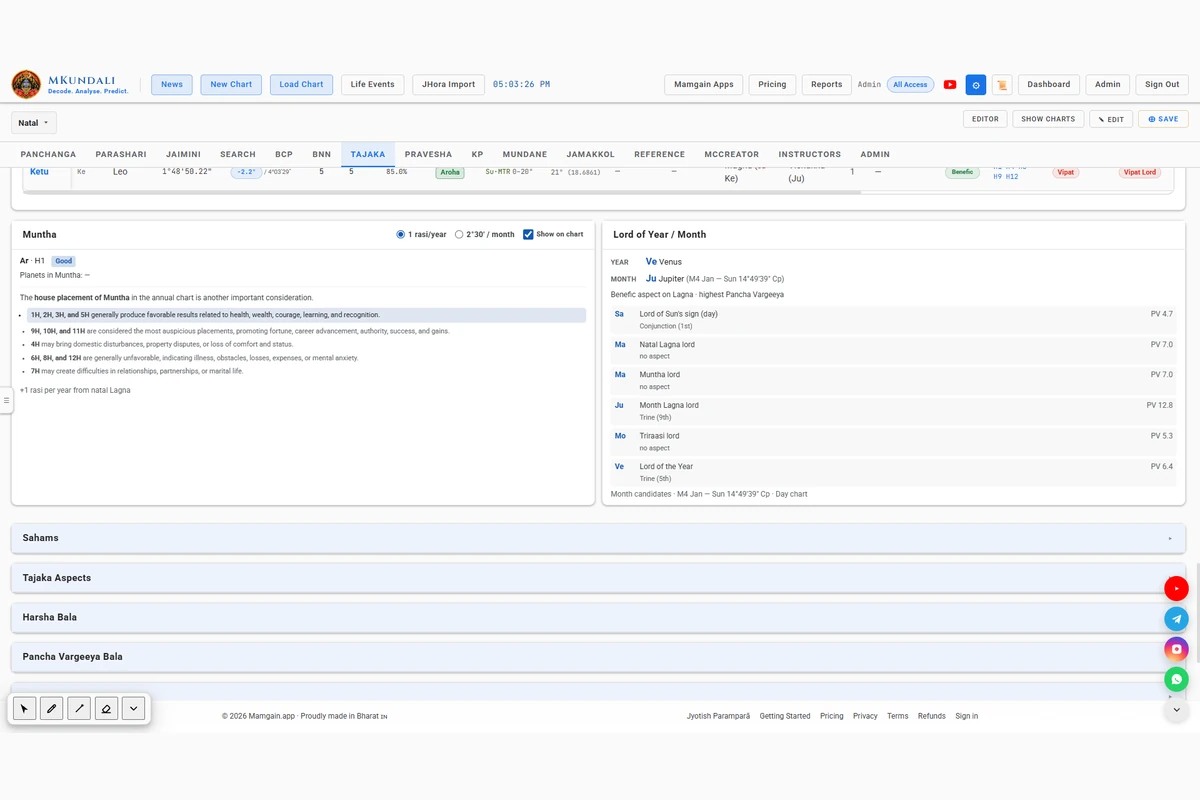
Muntha is an important reference in Tajaka annual chart analysis. MKundali calculates and displays Muntha using two available methods, chosen with a radio control in the Muntha card.

One Rashi per Year

Progress the natal Lagna by one sign for every completed year of life. This is the default method.

With this method selected, the Month and sub-hora views keep the annual Muntha, which is the same for every month.

Alternate: 2°30′ per Month

An alternate method progresses the natal Lagna longitude by 2°30′ for each monthly period.

  • Month 1 starts from the natal Lagna longitude
  • Month 2 advances by 2°30′
  • Later months continue the same way

This is an alternate method, not a rule laid down by the author, and the two methods are kept separate.

Muntha House Analysis

Review the house of Muntha in the annual chart. The Muntha card shows the house-quality indication and highlights the active row.

IndicationHouses
Excellent9H, 10H and 11H
Good1H, 2H, 3H and 5H
Bad6H, 8H and 12H
Caution (disputes, loss of position)4H
Caution (marriage, hardships)7H

These are the implemented traditional Tajaka indications, offered as a reference.

Chart Display

A Show on chart checkbox, on by default, toggles Muntha (Mu) on the Tajaka charts. Fusion outer layers show it too when the outer chart is a Tajaka level.

MKundali Tajaka Muntha and Lord of the Year cards
Muntha and the Lords of the Year and Month.

Section 9 of 16

Varsheshwara and Maasashwara – Examine the Lords of the Year and Month

MKundali provides separate calculations for the Lord of the Year and the Lord of the Month, shown in a card beside Muntha with their candidate lists.

Lord of the Year – Varsheshwara

Five candidate planets are examined on the annual chart:

  1. 1Day or night lord: the lord of the Sun's sign by day, or of the Moon's sign by night
  2. 2Natal Lagna lord
  3. 3Muntha lord
  4. 4Annual Lagna lord
  5. 5Triraasi lord of the annual Lagna

Lord of the Month – Maasashwara

Six candidates are examined on the monthly chart. The list follows the annual one, using the month chart's Lagna and Triraasi lords, and adds the Lord of the Year as a sixth candidate.

The two calculations are not identical: the monthly one has the extra candidate.

How the Lord Is Selected

Each candidate is checked for the Tajaka house aspect it casts on the Lagna, and for its Pancha Vargeeya Bala. A candidate with a benefic aspect on the Lagna is preferred, then one with a malefic aspect, and the strongest by Pancha Vargeeya Bala wins. A tie goes to the planet that appears most often among the candidates. The card shows the reason for the choice. Day or night is judged from sunrise and sunset against the Pravesh moment.

Section 10 of 16

Sahams – Examine Sensitive Points in Tajaka Charts

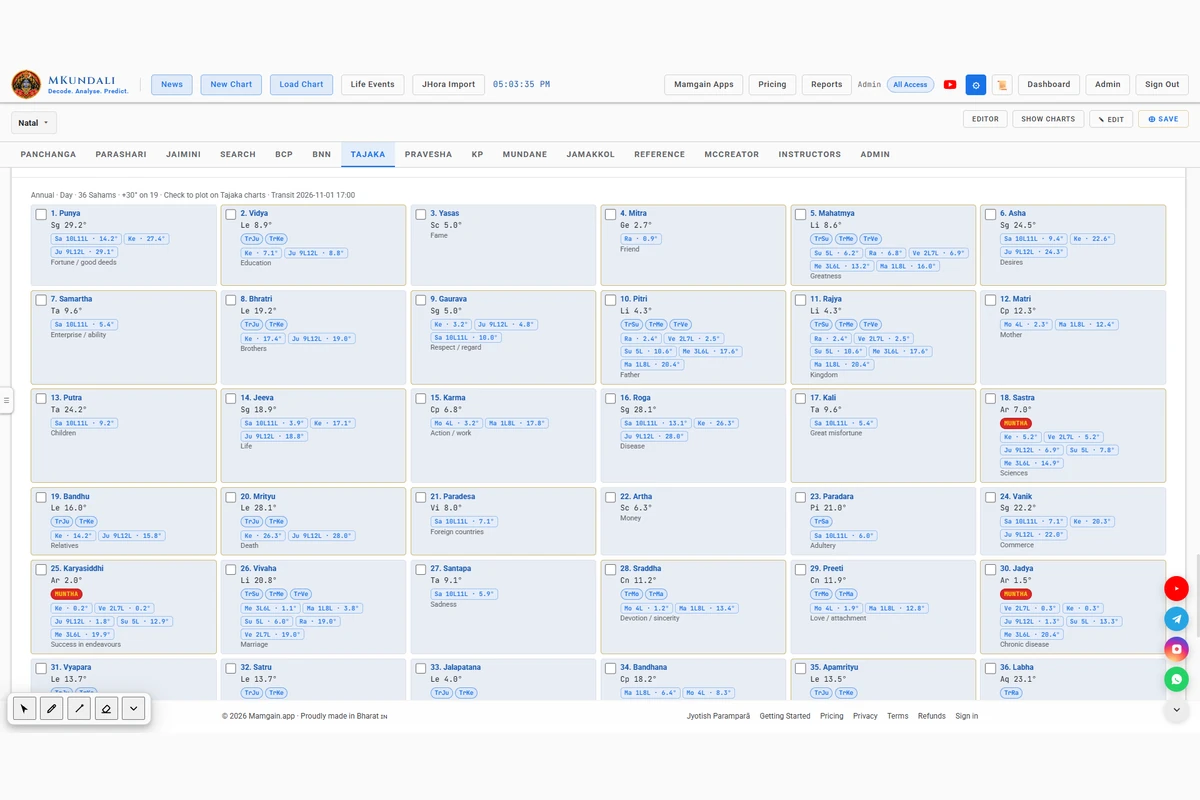
Sahams are calculated sensitive zodiacal points associated with selected areas of life. MKundali provides a dedicated Sahams card for examining these points in Tajaka charts.

Saham Calculations

  • Day charts: A − B + C
  • Night charts: B − A + C
  • +30° when C is not on the arc from B to A

Most Sahams flip A and B at night. Those marked otherwise keep their own day and night rule.

Not every Saham follows the same rule. Some have special formulas or depend on another Saham.

Saham Display

  • A card for each Saham
  • Zodiac position and sign
  • A checkbox to plot each on the charts
  • Parashari aspects from the chart to the Saham
  • Transit occupancy indicators
  • Responsive grid

All Saham chart markers are off by default and are selected one by one.

Thirty-Six Sahams

The implemented list runs from Punya to Labha and covers the 36 points of the reference set.

  • Punya
  • Vidya
  • Yasas
  • Mitra
  • Mahatmya
  • Asha
  • Samartha
  • Bhratri
  • Gaurava
  • Pitri
  • Rajya
  • Matri
  • Putra
  • Jeeva
  • Karma
  • Roga
  • Kali
  • Sastra
  • Bandhu
  • Mrityu
  • Paradesa
  • Artha
  • Paradara
  • Vanik
  • Karyasiddhi
  • Vivaha
  • Santapa
  • Sraddha
  • Preeti
  • Jadya
  • Vyapara
  • Satru
  • Jalapatana
  • Bandhana
  • Apamrityu
  • Labha
MKundali Tajaka Sahams grid with chart checkboxes
Sahams: calculated sensitive points with chart checkboxes.

Section 11 of 16

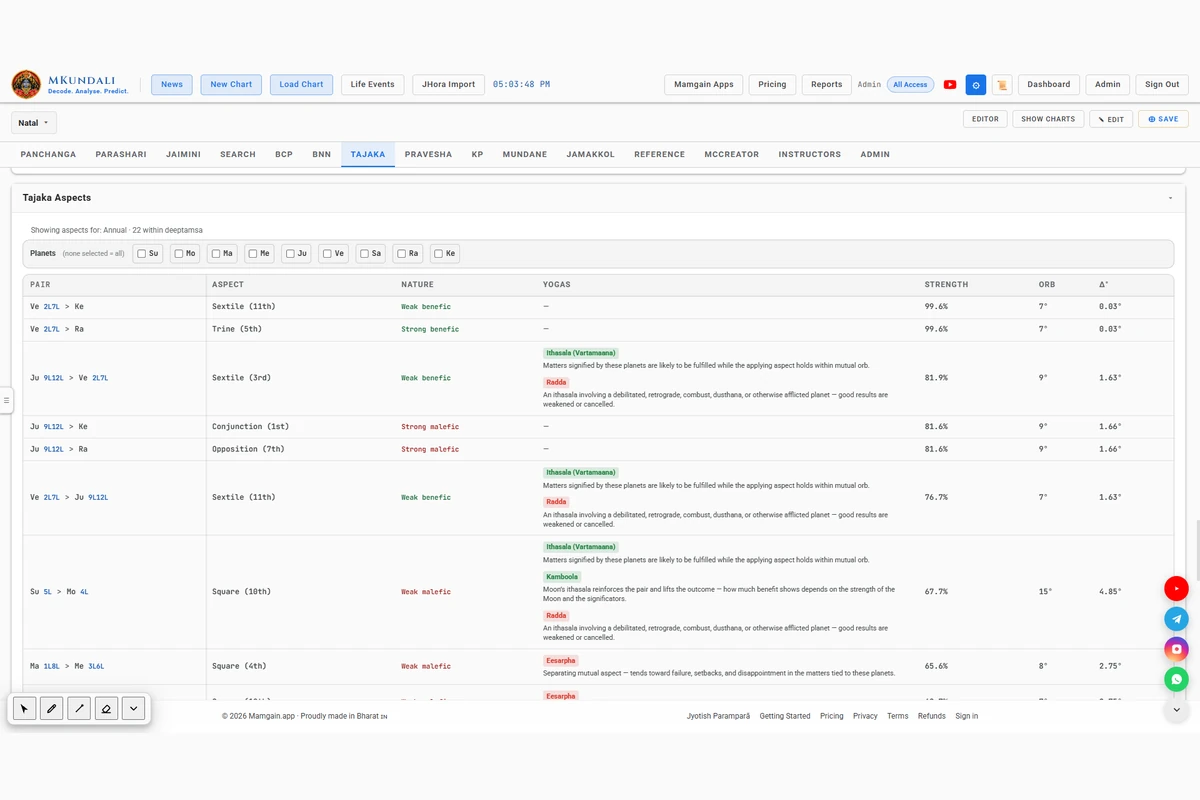
Tajaka Aspects – Examine Planetary Relationships and Strength

MKundali calculates Tajaka aspects using Western-style house relationships and planet-specific Deeptamsa orbs. They are separate from Parashari graha drishti.

Implemented Aspect Types

  • Conjunction
  • Semi-sextile
  • Sextile
  • Square
  • Trine
  • Opposition

Each type carries a nature, such as strong benefic for a trine or strong malefic for a conjunction or opposition.

Deeptamsa

Each classical planet has a Deeptamsa orb. It is used to assess the strength of its Tajaka aspect.

PlanetDeeptamsa
Sun15°
Moon12°
Mars8°
Mercury7°
Jupiter9°
Venus7°
Saturn9°

Strength is shown as a percentage: the closer to exact, the higher. An aspect outside the orb is not listed. Rahu and Ketu may be aspected, but this version does not give them aspects of their own.

Aspects Table

Review planet-to-planet aspects in the dedicated Tajaka Aspects table.

  • Pair (aspector › aspectee, with lordships)
  • Aspect type
  • Nature
  • Associated Yogas
  • Strength
  • Orb
  • Degree difference
  • Planet filters

Tick one or more planets to limit the table to aspects that involve them. With none ticked, all rows show.

Chart Aspect Overlays

On supported Tajaka charts, hover over a planet to draw its aspect arrows. The chart Options control switches Parashari and Tajaka arrows on or off independently. Each Tajaka arrow shows:

  • Aspect type
  • Strength percentage
  • Target planet
  • Pair Yogas, where present

Retrograde Motion

Retrograde motion can change how an applying Tajaka aspect, particularly Ithasala, is read. The motion-based checks are:

  • 1A faster retrograde planet moving away can cancel an applying Ithasala
  • 2A slower retrograde planet can strengthen a confirmed Ithasala
  • 3A faster retrograde planet moving towards the slower one may still form Ithasala
  • 4A faster planet that reaches its station before the exact aspect can cancel the expected formation

These checks use the actual planetary motion, not only a comparison of degrees.

MKundali Tajaka Aspects table with strength and orb
Tajaka Aspects: type, strength, orb and degree difference.

Section 12 of 16

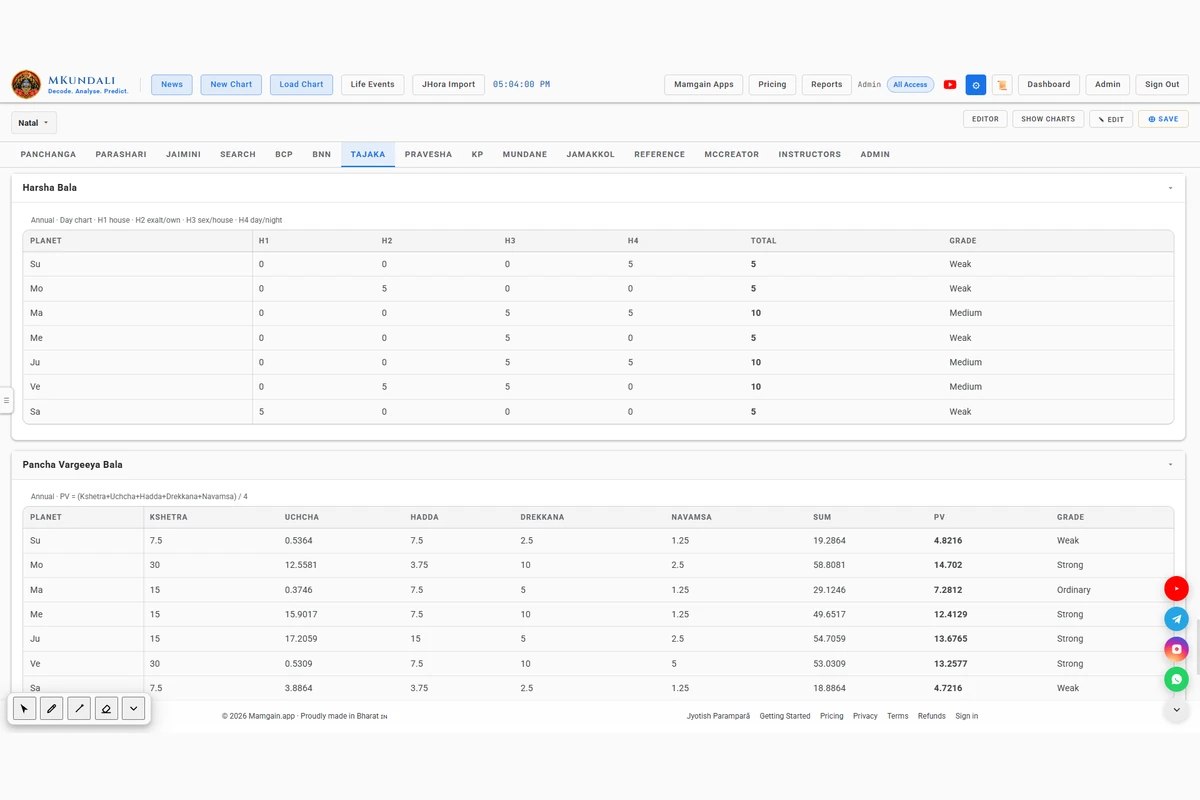
Tajaka Balas – Examine Annual Planetary Strength

MKundali provides three specialised Tajaka strength calculations for examining planets in annual charts.

Harsha Bala

Four strength factors, worth five units each, for a maximum of twenty:

  1. 1Prescribed house
  2. 2Exaltation or own sign
  3. 3Planetary sex versus house
  4. 4Day or night of the annual chart
TotalGrade
20Exceedingly Strong
15Fully Strong
10Medium
5Weak
0Nil

Pancha Vargeeya Bala

Five components are combined into one value and a grade for each planet.

  • Kshetra
  • Uchcha
  • Hadda
  • Drekkana
  • Navamsa

The table shows each component, their sum, the combined Pancha Vargeeya value and its grade.

Dwaadasa Vargeeya Bala

Evaluate planetary strength across twelve divisional charts, D1 through D12.

  • Strong Varga count
  • Weak Varga count
  • Dwaadasa Vargeeya result
  • Neutral classification preference

By default, neutral Varga placements are counted as weak. Switch off the Neutral → Enemy checkbox to leave neutral placements out of both the strong and weak counts.

Tajaka Balas are separate calculation systems. They are not classical Shadbala.

MKundali Tajaka Balas: Harsha, Pancha Vargeeya and Dwaadasa Vargeeya
Tajaka Balas: three strength tables.

Section 13 of 16

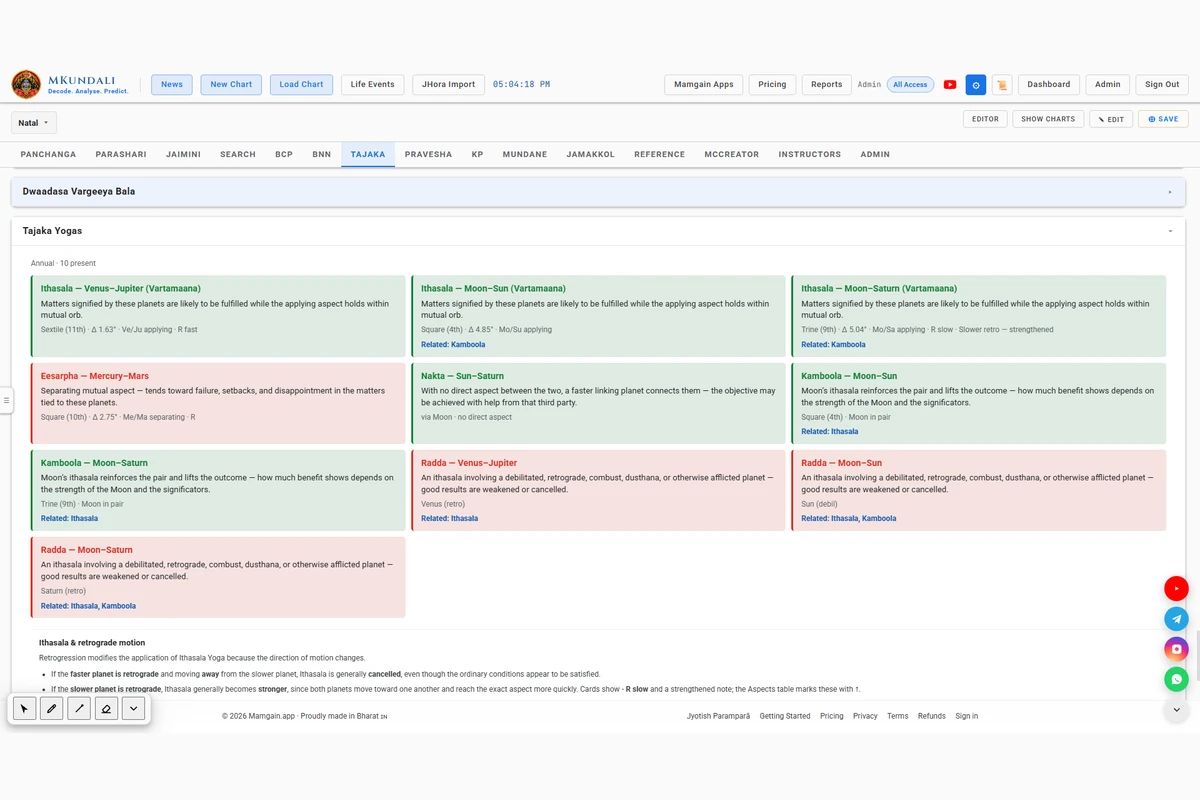
Tajaka Yogas – Examine Annual Planetary Combinations

MKundali identifies the implemented Tajaka Yogas for the selected annual or shorter-period chart and displays the Yogas that are present.

Sixteen Implemented Yogas

  • Ishkavala
  • Induvara
  • Ithasala
  • Eesarpha
  • Nakta
  • Yamaya
  • Manahoo
  • Kamboola
  • Gairi-Kamboola
  • Khallasara
  • Radda
  • Duhphali-Kutta
  • Duttota
  • Thambira
  • Kutta
  • Durupha

Present Yogas appear as cards with their name, a short explanation and extra detail where there is any. Yogas that are absent are hidden, and related Yogas on the same pair are cross-referenced.

Ithasala

An applying Tajaka aspect between two planets. One card is shown for each pair. The subtypes are:

  • Poorna
  • Vartamaana
  • Bhavishya

Eesarpha

A separating Tajaka aspect between two planets, where the faster planet has already passed the exact aspect.

Nakta

A mediated Yoga. The mediator is faster than both planets and forms Ithasala with each of them.

Yamaya

A mediated Yoga. The mediator is slower than both planets and forms Ithasala with each of them.

Other Tajaka Combinations

YogaIn brief
IshkavalaPlanets Sun to Saturn occupy only kendras and panapharas
InduvaraPlanets Sun to Saturn occupy only the 3rd, 6th, 9th and 12th houses
ManahooIthasala spoiled by Mars or Saturn conjunct the faster planet
KamboolaIthasala reinforced by the Moon's Ithasala with a member of the pair
Gairi-KamboolaA Moon in its last degree that waits to form Ithasala after changing sign
KhallasaraThe Lagna lord's sign lies between the Moon and another planet, with no Ithasala to either
RaddaIthasala with a member that is debilitated, retrograde or combust
Duhphali-KuttaIthasala where the slower planet is strong and the faster planet is weak
DuttotaIthasala between two weak planets, one of which has Ithasala with a strong third planet
ThambiraA planet at 29° or more that forms Ithasala with a slower planet after changing sign
KuttaA planet in the Lagna aspected by a planet in its own sign or exaltation in a kendra or panaphara
DuruphaIthasala where both planets are in the 6th, 8th or 12th house and each is combust, retrograde or debilitated

Strength, retrogression, combustion and association all enter these conditions. This is a short summary of the implemented rules, not a full account of the engine.

Implementation Notes

  • Ithasala uses the seven classical planets, Sun to Saturn
  • Rahu and Ketu pair Yogas are not included
  • Eesarpha does not yet use the motion gate that Ithasala uses

The Yoga engine covers the sixteen Yogas above. It does not claim to cover every Tajaka Yoga in every classical text.

MKundali Tajaka Yogas cards for the selected chart
Tajaka Yogas: cards for the Yogas present.

Section 14 of 16

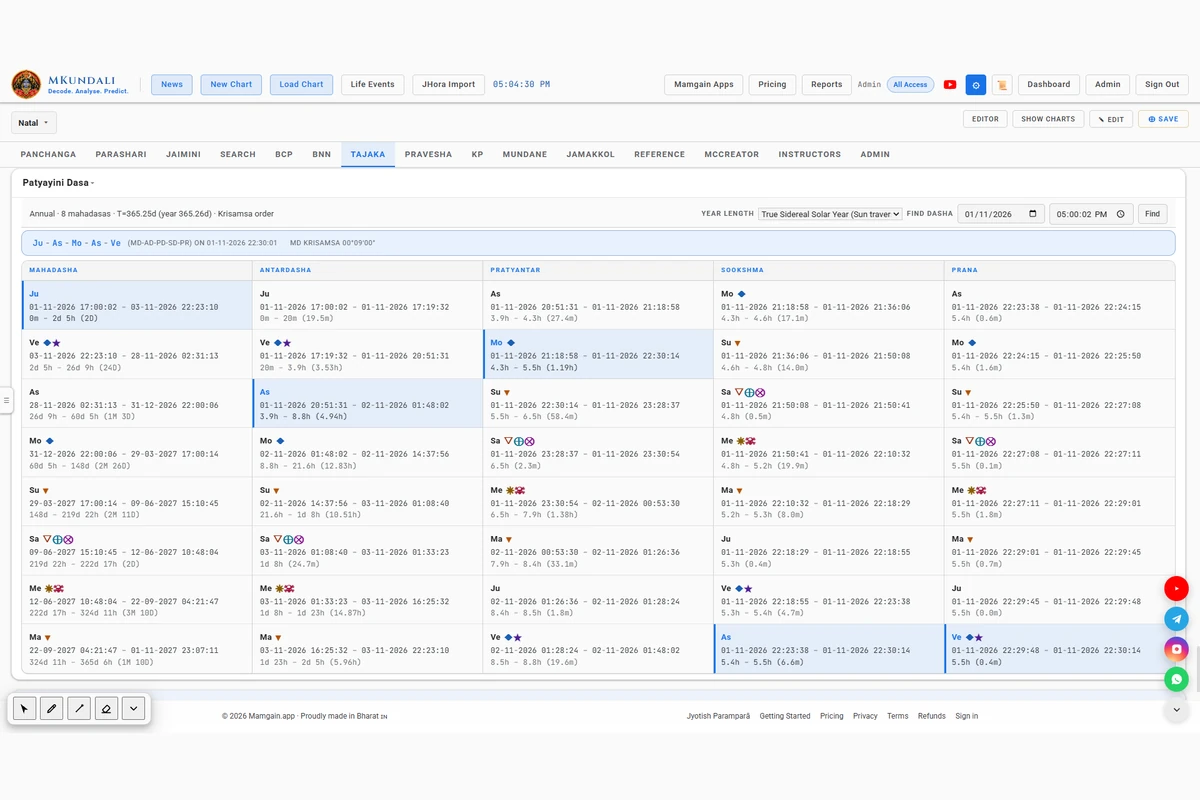
Patyayini Dasa – Examine the Annual Planetary Period Sequence

MKundali includes Patyayini Dasa for the annual Tajaka chart. The calculation uses the longitudes of the Lagna and the seven classical planets, Sun through Saturn.

How It Works

  • Krisamsa
  • Patyamsa
  • Mahadasha sequence
  • Antardasha calculations
  • Planetary order
  • Dasha duration
  • From and To dates
  • Dasha lookup by date and time

The Mahadasha table lists lord, Krisamsa, Patyamsa, fraction, days, and the From and To dates. Select a Mahadasha row to see its Antardashas.

Year-Length Options

  • Mean Sidereal Solar Year
  • Mean Tropical Solar Year
  • True Tropical Solar Year
  • True Sidereal Solar Year
  • Savana Year
  • Year with 360 Tithis
  • User Defined Year

The selector starts at the Mean Sidereal Solar Year.

Patyayini Dasa is presented for the Annual Tajaka chart only. It is not offered for the monthly or sub-hora charts.

MKundali Patyayini Dasa table with year-length options
Patyayini Dasa for the Annual chart.

Section 15 of 16

Mudda Dasa – Examine the Varsha Vimshottari Sequence

Mudda Dasa is a compressed Vimshottari Dasha system implemented for the Tajaka annual chart.

What It Shows

  • Annual starting Dasha Lord
  • Start based on the natal Moon's Nakshatra
  • Remaining balance
  • Mahadasha sequence
  • Antardasha sequence
  • Period duration
  • Date-based lookup

A Compressed Annual Cycle

The Mudda sequence fills one year of 360 days. It uses the implemented Mudda period table, in which each Vimshottari period of years becomes the same number multiplied by 3 in days (the Sun's 6 years become 18 days), and the natal Moon's Nakshatra position.

A year-length selector is provided. It starts at the Savana Year of 360 days.

Mudda Dasa is not ordinary full-length Vimshottari Dasha. It is available for the Annual chart only.

MKundali Mudda Dasa table with Mahadasha and Antardasha
Mudda Dasa for the Annual chart.

Section 16 of 16

Sudarshan Chakra Dasa – Examine the Annual House Cycle

MKundali includes annual Sudarshan Chakra Dasa for examining the house associated with each year of life.

The Annual House

  • 1One house is assigned to each year of life
  • 12The cycle repeats every twelve years
  • LThat house is counted from the natal Lagna
  • MThe same house is counted from the natal Moon
  • SAnd from the natal Sun

What You See

  • Three-reference table: reference, reference sign, house sign
  • 12-year cycle table: year and house
  • Find Dasha by date and time

Sudarshan Chakra Dasa is implemented for the Annual chart only.

MKundali annual Sudarshan Chakra Dasa with Lagna, Moon and Sun references
Annual Sudarshan Chakra Dasa and its 12-year cycle.

Why MKundali

A Complete Workspace for Tajaka Analysis

Traditional Tajaka analysis involves annual charts, successive solar divisions, Muntha, special points, planetary strengths and timing systems. MKundali brings these tools together within a structured workspace.

  • Exact annual Varsha Pravesh
  • Twelve Maasa Pravesh charts
  • Shashti-hora 60-hour divisions
  • Nested 05-Hours, 25-Mins and 2-Mins charts
  • Tajaka divisional and Fusion Charts
  • Two Muntha calculation methods
  • Lord of the Year and Month
  • Thirty-six Sahams
  • Tajaka house aspects and Deeptamsa
  • Harsha Bala
  • Pancha Vargeeya Bala
  • Dwaadasa Vargeeya Bala
  • Sixteen implemented Tajaka Yogas
  • Patyayini Dasa
  • Mudda Dasa
  • Annual Sudarshan Chakra Dasa

MKundali provides calculation and analysis tools. Interpretation remains with the astrologer, and the tools do not guarantee the accuracy of any prediction. Explore the related Parashari, KP, BNN and BCP workspaces. For the Moon-based Annual, Month and Day returns, see Pravesha astrology software. For calendar and eclipse charts, see Mundane astrology software.

FAQ

Frequently Asked Questions

What is Tajaka astrology?

Tajaka, also known as Tajika, is an astrological system that includes annual Varsha Pravesh charts, shorter-period Pravesha charts, Muntha, Tajaka aspects, Yogas and planetary strength calculations.

Does MKundali support annual Varsha Pravesh?

Yes. It calculates the exact annual return of the Sun to its natal sidereal longitude using the birth location.

Does MKundali support monthly Tajaka charts?

Yes. It supports twelve Maasa Pravesh charts within each annual Tajaka cycle.

What is Shashti-hora?

Shashti-hora is a 60-hour Tajaka period. MKundali calculates twelve such periods per Maasa Pravesh using successive 2°30′ solar movements.

What are 05-Hours, 25-Mins and 2-Mins?

They are three nested sub-hora levels. Each parent interval is divided into twelve equal solar-arc subdivisions.

Does MKundali include Muntha?

Yes. It provides the annual one-Rashi-per-year method and an alternate 2°30′-per-month method.

What are Sahams in MKundali?

Sahams are calculated sensitive zodiacal points associated with specific areas of life. MKundali provides a dedicated collection of thirty-six implemented Sahams.

Which Tajaka Balas are available?

Harsha Bala, Pancha Vargeeya Bala and Dwaadasa Vargeeya Bala.

Does MKundali identify Tajaka Yogas?

Yes. The implemented Yoga engine identifies the available Tajaka combinations and displays the Yogas present in the selected chart.

Which Dasha systems are available in Tajaka?

The annual Tajaka workspace includes Patyayini Dasa, Mudda Dasa and Sudarshan Chakra Dasa.

Are all Tajaka features available in every subscription?

Access to individual tools may depend on subscription plans and entitlements. Refer to the Pricing page for current availability.

Explore Tajaka Astrology with MKundali

From annual Varsha Pravesh to monthly and 60-hour charts, Muntha, Sahams, Tajaka Yogas and annual Dasha systems, explore a comprehensive Tajaka workspace in MKundali.